
AI Monitoring Tools: What to Measure Before You Buy
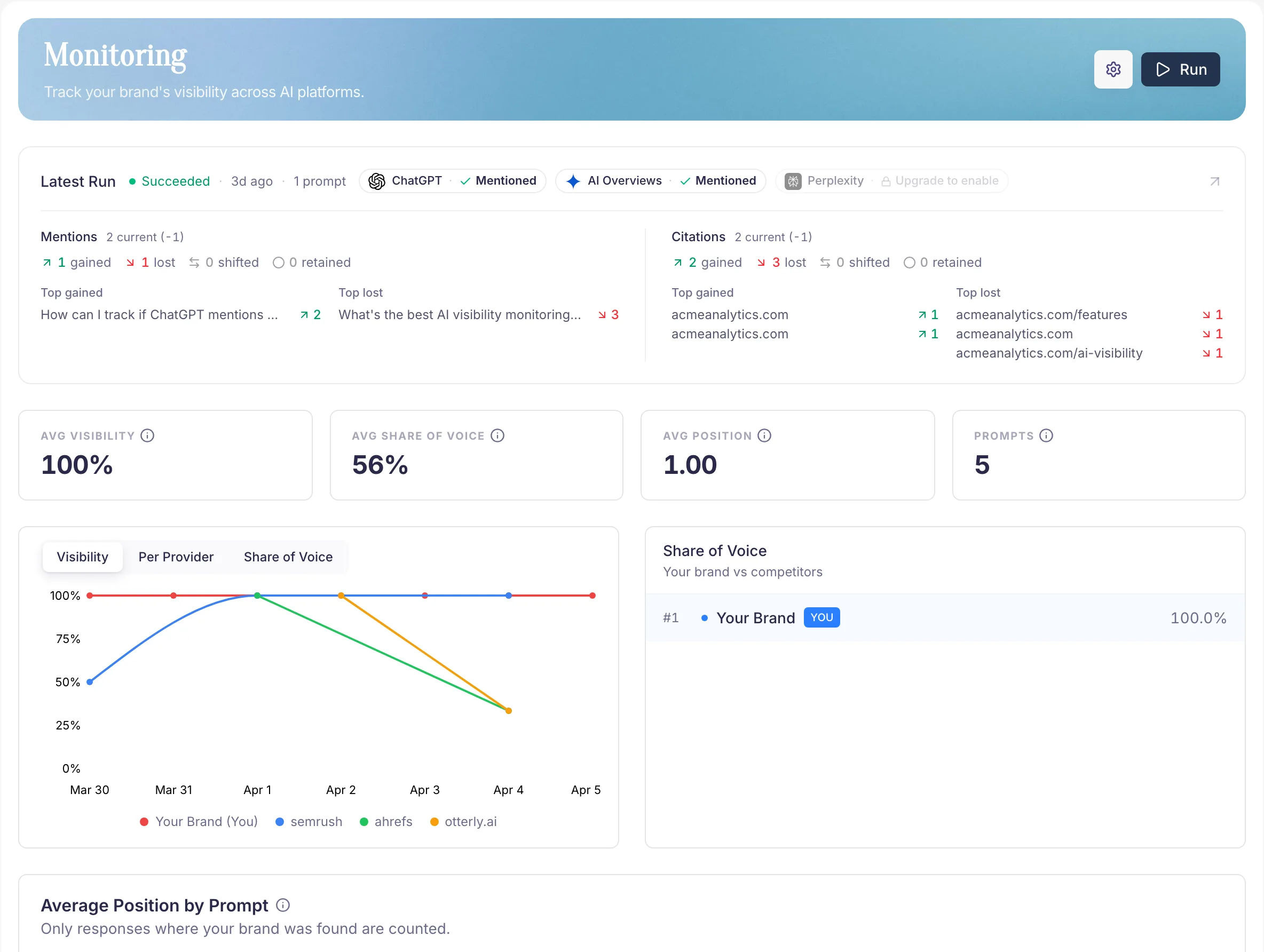
An AI monitoring tool should measure whether your brand appears in buyer-style AI answers, how that visibility changes by provider, which competitors appear instead, and which cited sources explain the result. The right tool gives you repeatable prompts, provider coverage, citations, competitor context, reporting, exports, and a pricing model that fits the workflow you will actually run.
- No credit card required
Buyer Checklist
Use these criteria to compare monitoring workflows before you commit budget or client reporting time.
| Decision point | PromptScout workflow | What to verify elsewhere |
|---|---|---|
| Provider coverage | ChatGPT, Gemini, Google AI Overviews, and Perplexity | Check whether coverage matches the AI surfaces your buyers use |
| Prompt scheduling | Recurring prompt monitoring with historical trend context | Avoid tools that only support one-off snapshots for recurring reporting |
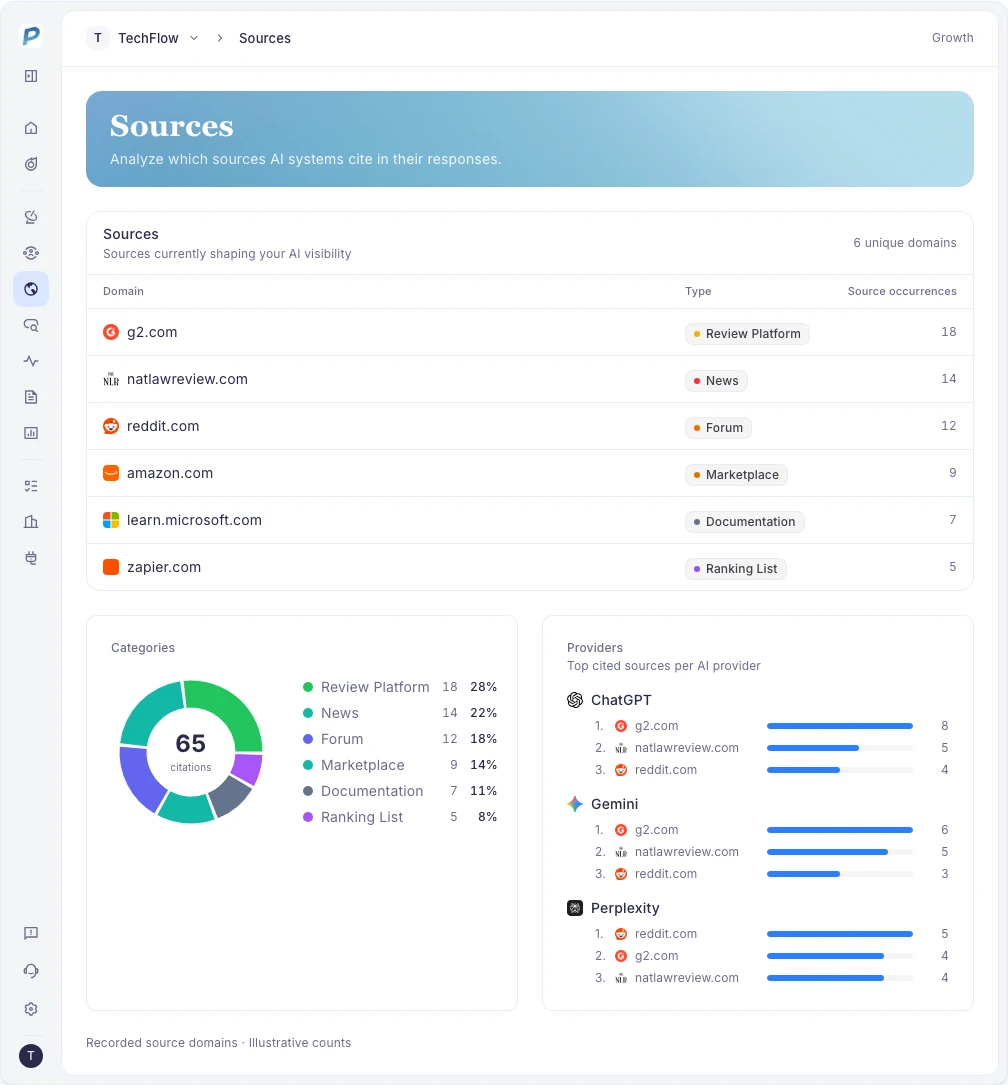
| Citations and source visibility | Source tables show cited URLs, domains, and source categories | Verify that the tool captures source evidence, not only brand mentions |
| Competitor tracking | Competitors are extracted and compared on the same prompt set | Look for shared prompts so share-of-voice comparisons are fair |
| Reporting and exports | Weekly reports and dashboard evidence for team review | Confirm whether outputs work for stakeholders or need manual cleanup |
| Pricing fit | Free technical audit, account setup, and published paid plans for focused monitoring | Match cost to the number of brands, prompts, providers, and users |
Who AI monitoring tools are for
AI monitoring tools are for teams that need a repeatable answer to a buying question: when prospects ask ChatGPT, Gemini, Google AI Overviews, or Perplexity about a category, does the brand appear, who appears instead, and which sources shape the answer?
- Founders checking whether AI recommendations include their product
- SEO and content teams comparing source coverage across providers
- Agencies packaging AI visibility reporting for clients
- Operators who need trend data instead of one-off manual prompt checks
When not to prioritize AI monitoring tools
Do not buy a monitoring platform just because the category is noisy. If your team cannot name the buyer questions that matter, start with a small prompt set and a free visibility check before expanding into scheduled tracking.
- If you only need a one-time audit, start with a free report card first
- If you need classic rank tracking only, keep your SEO tool as the source of truth
- If nobody owns weekly review, assign the workflow before adding more data
AI monitoring tools implementation checkpoints
A useful buyer guide should make tradeoffs visible. Compare provider coverage, prompt scheduling, citation and source capture, competitor tracking, reporting, exports, and pricing fit before you pick a tool.
- Run the same buyer prompts across providers to spot provider-specific gaps
- Review citations and source domains so you know what evidence is shaping answers
- Use reporting and exports only after the prompt set is stable enough to compare over time
Evidence and validation notes for AI monitoring tools
Market-level citation research points in the same direction: provider preferences vary, off-site sources matter, and comparison tables make buyer pages easier to extract. Google also says AI features still depend on crawlable, indexable, textual pages with useful supporting media.
- Search Engine Land's Peec coverage found Reddit, YouTube, LinkedIn, Wikipedia, Forbes, Yelp, and G2 showing up differently by provider and query type
- Search Engine Land's Tinuiti coverage warns against assuming one universal source mix across every brand or vertical
- Cleanlist's Q1 2026 B2B dataset found explicit comparison tables and proprietary numeric data correlated with higher citation rates
- Google Search Central says pages need crawl access, internal links, textual content, matching structured data, and useful images when relevant
Related Guides
Explore these guides to learn more about AI visibility, optimization strategies, and best practices.
ChatGPT Brand Tracker
Monitor configured ChatGPT prompts over time and compare brand mentions against competitors.
Explore feature
AI Brand Monitoring Platform
Track how ChatGPT, Gemini, Google AI Overviews, and Perplexity mention your brand over time.
Explore feature
AI Brand Visibility Workflow
Use recurring prompt tracking to measure how your brand's AI visibility changes week to week.
Explore feature
ChatGPT Brand Tracker
Practical setup for tracking brand mentions and recommendations in ChatGPT.
Read guide
PromptScout for Agencies
Package multi-brand AI visibility monitoring for client reporting across supported providers.
See pricing or create account
Why ChatGPT Is Not Mentioning Your Brand
Diagnose why your brand is missing in AI answers and follow a practical recovery plan.
Explore feature
Frequently Asked Questions
What should an AI monitoring tool measure first?
Start with recurring buyer prompts, provider-level brand mentions, competitor appearances, cited sources, and trend movement. Those signals explain whether visibility is repeatable or just a one-time answer.
Is an AI monitoring tool the same as an SEO tool?
No. SEO tools remain useful for rankings, links, and technical search work. AI monitoring tools focus on generated answers, mentions, citations, and provider differences.
When is PromptScout a good fit?
PromptScout is a good fit when you need fast, repeatable visibility monitoring across the four supported providers without an enterprise implementation cycle.
Related Features
Multi-Provider AI Monitoring
Monitor your brand across ChatGPT, Gemini, Google AI Overviews, and Perplexity from one dashboard. Compare provider coverage, answers, and trend changes.
Explore Multi-Provider AI MonitoringAI Brand Visibility Score
Track your AI brand visibility score over time. Measure mentions, provider differences, competitor context, and visibility movement across key questions.
Explore AI Brand Visibility Score