
PromptScout Blog
When Your Site Appears in AI Sources but Your Brand Is Missing
Audit AI answers that return a page on your site without naming your brand. Check the answer, source link, page role, and buyer question before editing content.
Published

Founder
Building PromptScout to help teams understand how AI assistants cite, mention, and recommend their brands.
Your brand in AI answers
See where AI recommends your competitors.
Start with a free visibility check. Paid plans add monitoring; Growth adds Opportunities.
Paid monitoring: ChatGPT Gemini AI Overviews Perplexity Bing Copilot
If an AI answer returns a page on your site but leaves your brand out of the answer text, inspect the page and the buyer question together. First check whether the URL was visibly linked in the answer. Then ask whether the page explains your business or merely supplies a useful fact. A source-list entry alone does not establish a recommendation.
Summary
This is a page-level audit, not a reason to rewrite your whole site. Save the question, provider, answer date, returned URL, and answer wording. Open the page and check whether a reader could tell who provides the information and what that business is for. Repeat the same question before treating one omission as a pattern.
The distinction matters because a system may return a source URL without showing it as a link in the final answer. A visible link, a brand mention, and a recommendation are separate observations. Our guide to AI visibility metrics explains those layers; this article starts after you find the specific source-and-name mismatch.
The pattern in our sample
In a recent production monitoring slice, 131 completed answers returned at least one URL on the monitored brand's own domain. The brand was detected in the answer text for 119 of those answers and was not detected for 12. That is a narrow observation about returned URLs and detected names, not a count of visible citations or a measure of how often AI recommends a business.
GrowByData published a related self-audit. It found that its website appeared as a source more often than its brand appeared in answer text. Its prompts and classification belong to its own product audit; the counts above come from a separate sample. Neither study shows that adding a brand name to a page will cause an AI answer to recommend it.
The source gap checklist
Keep the source record and the answer open side by side. The first pass takes only a few minutes:
| Check | Record |
|---|---|
| Link display | Was your URL visible to the reader, or only present in a returned source list? |
| Answer wording | Did the answer name your brand, describe a category, list alternatives, or recommend a specific business? |
| Question intent | Was the person asking for a fact, a method, or a shortlist of providers? |
| Page role | Is the URL a product or service page, a guide, a definition, or a research page? |
A missing brand name is more consequential in a shortlist answer than in an answer to a general definition. A guide can be useful background for a category question without being a plausible vendor recommendation. Conversely, a product page returned for a buyer question deserves closer inspection if the answer names competing options but omits the business on that page.
Check the visible answer itself. OpenAI's ChatGPT Search guide distinguishes cited sources from other relevant links in its Sources view. Google's guidance describes supporting links in AI Overviews and AI Mode. A returned URL does not prove the page supplied a particular sentence, and a brand name in a source title does not mean the answer text named the brand. Save the exact evidence layer you observed rather than upgrading one into another.
What the paired signals show
The full PromptScout sample shows why an audit needs both fields. A brand was named in 135 answers without an own-domain URL in returned sources. That field may contain other domains or no URL; this is not a count of answers without citations.
| Own-domain URL in returned sources | Brand named in answer | Brand not detected in answer |
|---|---|---|
| Yes | 119 | 12 |
| No | 135 | 465 |
Anonymized production monitoring, August 26–September 24, 2026 UTC. Unit: 731 successful answers with completed brand-mention processing. “No” means no exact match to the monitored brand's domain in returned source URLs.
The gap also needs a provider label. In this sample, 9 of the 12 own-domain URL and missing-name answers came from Perplexity. The chart gives the count and denominator for each provider with an eligible own-domain URL. It describes these captured answers; the brand mix and sample sizes differ, so it does not rank providers.
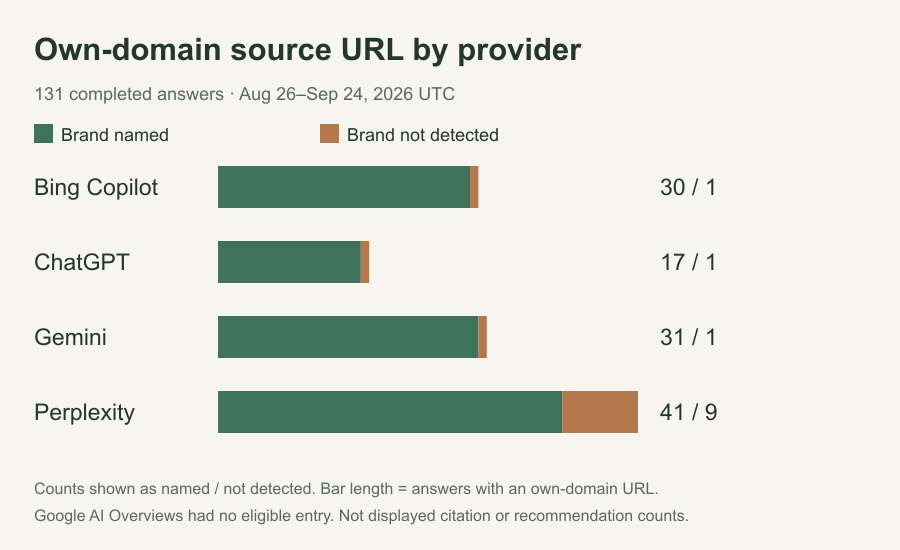
Production monitoring, August 26–September 24, 2026 UTC. Unit: answers with an own-domain URL in returned sources. Google AI Overviews had no eligible own-domain URL recorded in this field, so it is not plotted. These are not displayed-citation or recommendation counts.
The 12 gap answers covered nine provider-and-question pairs. Three pairs appeared twice in the window; six appeared once. Recheck the same question and provider before treating a single omission as a recurring pattern.
Inspect the linked page
Read the page as if its heading and first useful section were shown without the rest of your site. Does the page name the business in plain language? Does it state what it offers, who it serves, and when it is a suitable choice? If it is a guide or study, does the byline or research description make the publisher clear without interrupting the answer?
Then compare the page with the question. If the question asks for a comparison, a generic guide may answer the subject but never explain the business's fit. If the question asks for a fact, the omission may be entirely appropriate. Make one page edit only when you can name the missing information a human reader also needs. Adding a repeated brand name to every paragraph is not a substitute for that information.
Also inspect the other visible sources and named competitors. They may show whether the answer relied on a review, a directory, a competitor's page, or your own guide for different parts of the response. Do not assume the returned URL was the reason another brand was named.
A compact client note
An agency can record the outcome without turning it into a visibility score:
“For this buyer question, the answer's source list included a page on the client's domain, but the answer text did not name the client. We are checking whether the link was displayed, what the page explains about the business, and whether the same pattern repeats. We have not counted this as a recommendation or a referral.”
This note gives the client one page to review and one result to recheck. It also leaves room for a legitimate finding that no content change is needed.
Using PromptScout
Keep a small group of buyer questions in PromptScout and review each completed answer with its provider and returned sources. For a source-and-name mismatch, open the linked page, inspect the answer wording, and save the page-level finding. Check competitor names separately. On the next monitoring cycle, use the same question group to see whether the mismatch recurs. The supported providers are ChatGPT, Gemini, Google AI Overviews, Perplexity, and Bing Copilot; results from one provider should remain labeled as that provider's observations.
For a broader source audit, see source gaps versus content gaps. For the distinction between an answer that names a brand and one that recommends it, use the AI visibility metrics guide.
Verify the next observation
Repeat the same buyer question with the same provider and market settings. Record whether the URL returned again, whether the link was displayed, and whether the answer named the business. If you edited a page, log the edit date and the exact section changed. A later change in the answer is a follow-up observation; it does not, by itself, prove the page edit caused it.
Notes on the data
The chart uses a read-only aggregate of production monitoring from August 26 through September 24, 2026 UTC. It includes 731 successful answers with completed brand-mention processing across 62 tracked questions and five monitored brands. A normalized, exact hostname match found the monitored brand's domain in returned source URLs for 131 answers. Of those, 119 had a detected monitored-brand mention in answer text and 12 did not. Those 12 answers covered eight questions and two brands. The sample is small and uneven across providers; incomplete mention processing and answers outside this window were excluded. Returned source URLs are not a verified count of reader-visible citations. No raw customer questions, answers, domains, or account details are used here.