
AI Competitor Analysis
AI competitor analysis compares how AI systems mention, recommend, rank, and cite your brand versus competitors across a fixed prompt set. The goal is not to invent AI ranking factors; it is to find observed answer patterns you can measure again after content, source, or positioning work.
- No credit card required
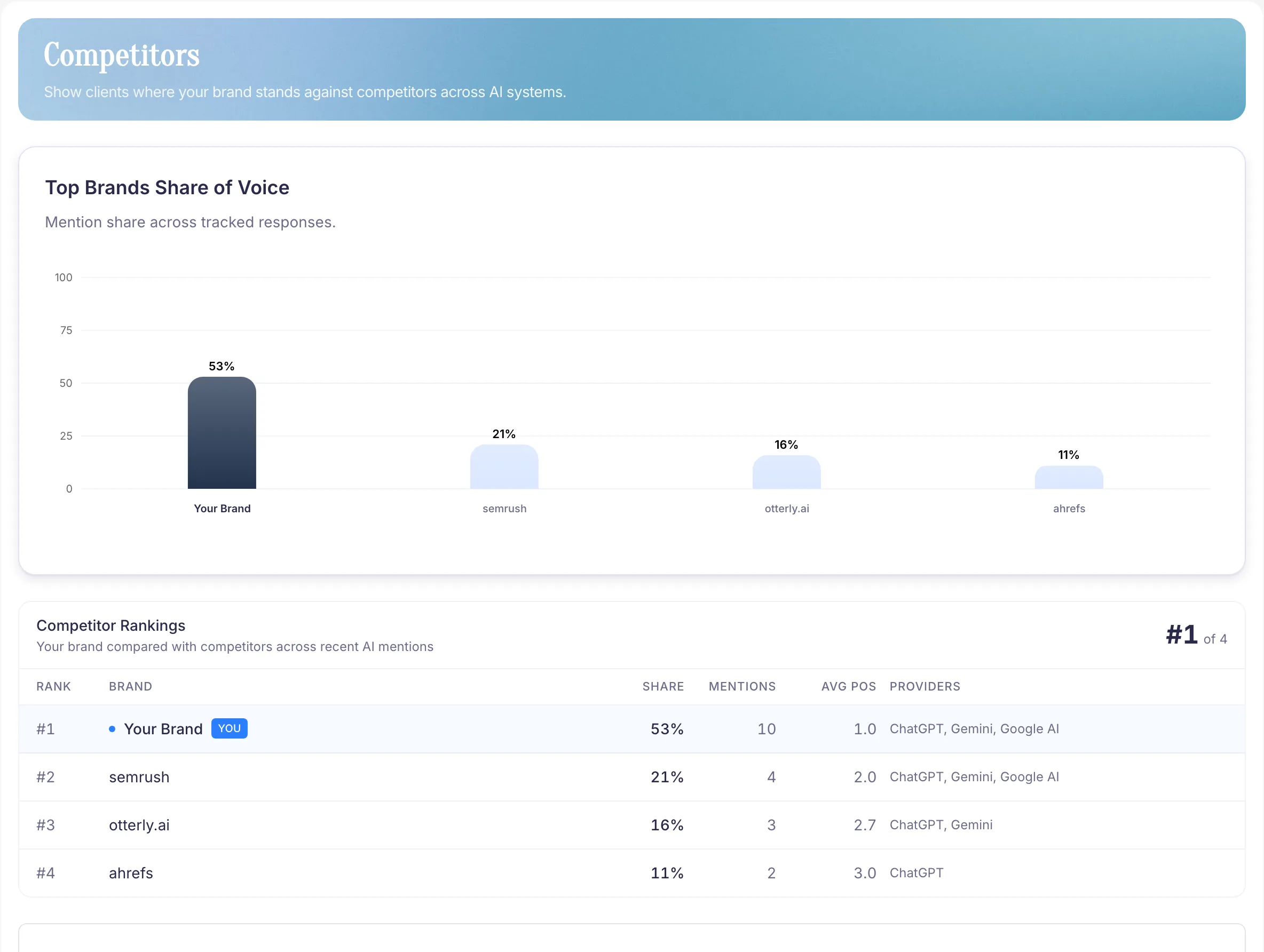
Competitor workflow table
Start by defining the fixed prompt set and competitor roster before looking at outputs. Then collect a provider split, calculate share-of-voice measurement, inspect citation and source evidence, and prioritize actions only where the observed gap repeats.
- Prompt set: use category, comparison, pricing, alternative, and evaluation prompts that match real buyer language
- Provider split: compare ChatGPT, Gemini, Google AI Overviews, and Perplexity separately before blending results
- Competitor roster: freeze the brands you are benchmarking so Share of Voice is stable across runs
- Share-of-voice measurement: count de-duplicated direct-brand appearances in the fixed competitive set
- Citation/source review: separate owned URLs from reviews, directories, editorial rankings, community, social, documentation, AI/search, and other sources
- Action prioritization: pick changes where the same competitor advantage appears across repeated prompts or providers
| Workflow step | Decision it supports | Evidence to preserve |
|---|---|---|
| Prompt set | Which buyer questions and comparison prompts define the market | Prompt text, cluster, intent, and run cadence |
| Provider split | Where ChatGPT, Gemini, Google AI, and Perplexity disagree | Provider-level Appearance Rate and Citation Presence |
| Competitor roster | Which brands count in Share of Voice calculations | Frozen benchmark roster and direct-brand aliases |
| Citation review | Whether competitors win through owned pages or third-party proof | Source URLs, Citation Rank, and source-category mix |
| Action priority | Which content, source, or positioning gaps repeat enough to work on | Repeated prompt-cluster movement after changes |
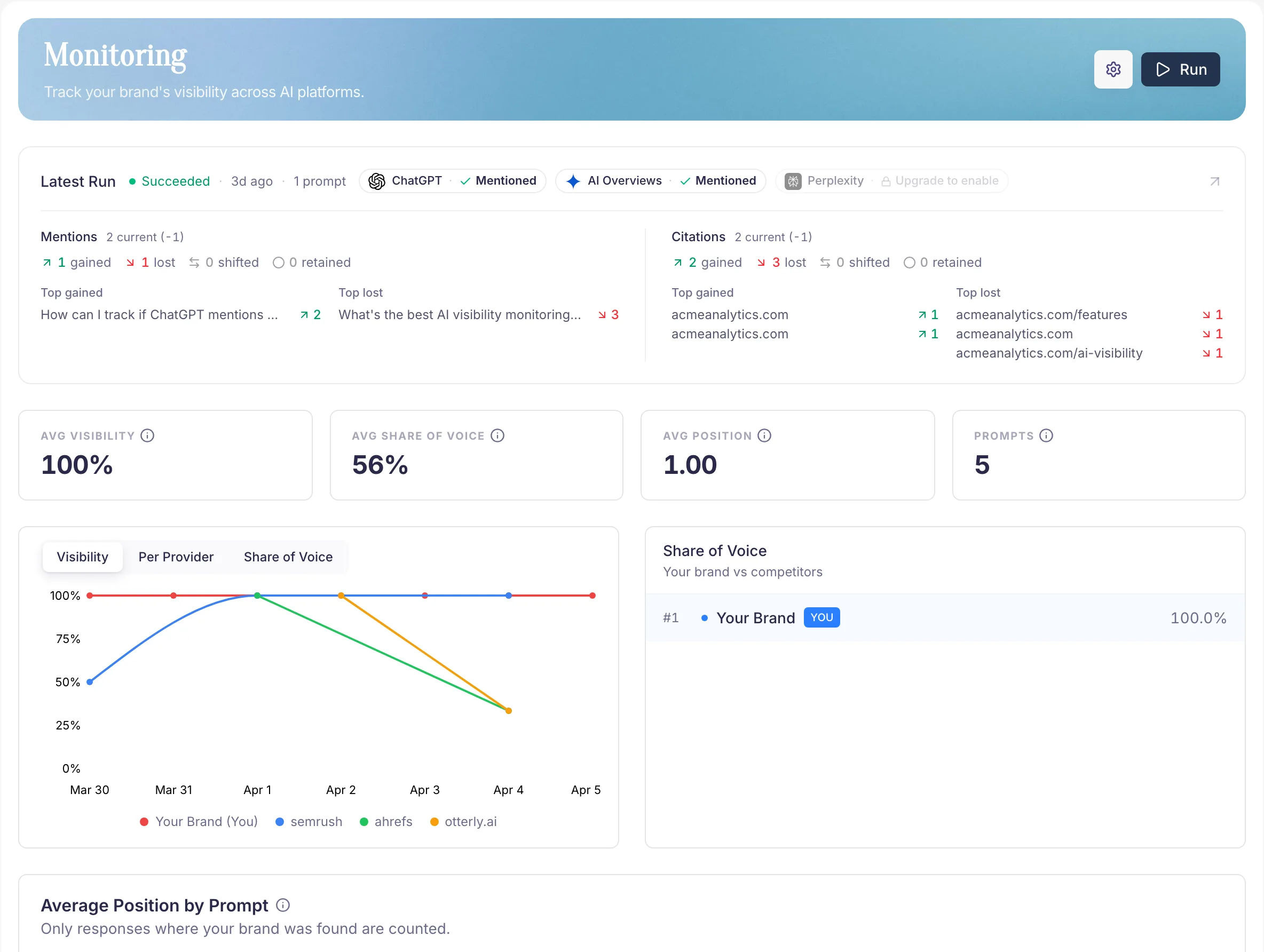
Sample, not a live benchmark
Example output should be clearly labeled when it is synthetic. A useful sample gap table shows the competitor, repeated prompt cluster, observed provider pattern, cited source type, and next action without pretending the data is a live benchmark.
- Competitor A: appears in comparison prompts on two providers; source pattern is review and directory coverage; next action is comparison evidence and third-party profile cleanup
- Competitor B: cited from owned documentation in implementation prompts; next action is clearer docs and use-case pages for the same prompt cluster
- Competitor C: mentioned often but rarely cited; next action is source inspection before assuming content volume is the gap
| Competitor | Repeated gap | Observed source type | Next action |
|---|---|---|---|
| Competitor A | Appears in comparison prompts on two providers | Review and directory pages | Add comparison evidence and clean up third-party profiles |
| Competitor B | Cited from owned docs in implementation prompts | Documentation | Improve docs and use-case pages for the same prompt cluster |
| Competitor C | Mentioned often but rarely cited | Mixed, low-repeat citations | Inspect cited sources before assuming content volume is the gap |
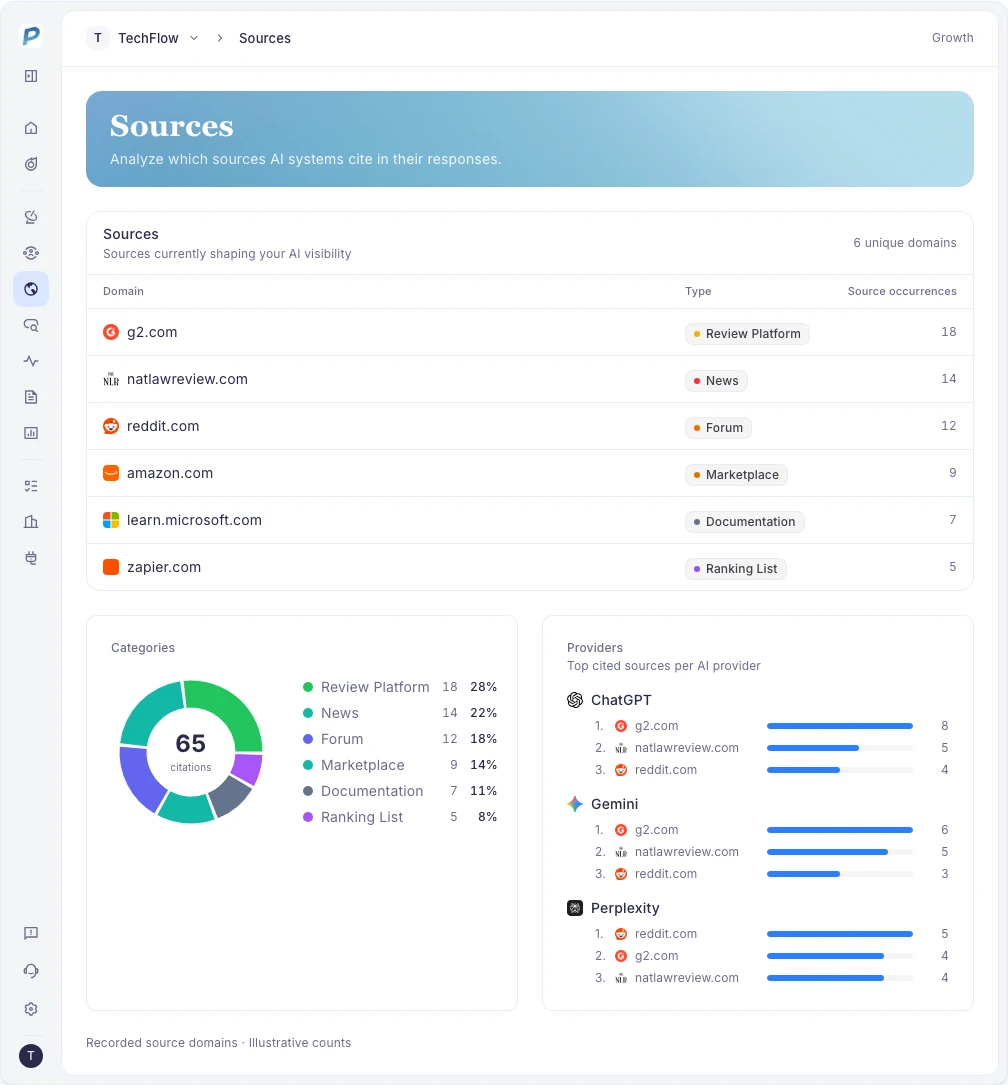
How each team should use the data
Different teams need different decisions from the same competitor evidence. Keep the shared view stable, then let each role decide the next action from the observed answer patterns.
- Marketers should turn repeated competitor gaps into content briefs, comparison tables, and proof blocks
- SEO teams should connect AI answer gaps to crawlable pages, internal links, schema fit, and source-category mix
- Agencies should report provider-level changes and caveats instead of selling one blended AI score
- Founders should use the competitor roster to decide where positioning, category language, or third-party proof is missing

Guardrails for AI competitor claims
AI citation patterns vary by platform, category, and intent, so competitor analysis should use explicit methodology and avoid universal ranking-factor certainty. Report what the fixed prompt set observed, disclose sample limits, and rerun the same prompts before calling a movement durable.
- Avoid saying a model ranks brands because of one page, backlink, or schema field
- Use sample sizes and provider splits when sharing Citation Presence or Citation Rank
- Preserve the prompt set and competitor roster when comparing one run to the next
Related Guides
Explore these guides to learn more about AI visibility, optimization strategies, and best practices.
AI Competitor Analysis
Measure share of voice in AI answers and benchmark competitors.
Explore feature
ChatGPT Brand Tracker
Monitor configured ChatGPT prompts over time and compare brand mentions against competitors.
Explore feature
ChatGPT Brand Tracker
Practical setup for tracking brand mentions and recommendations in ChatGPT.
Read guide
AI Brand Monitoring Platform
Track how ChatGPT, Gemini, Google AI Overviews, and Perplexity mention your brand over time.
Explore feature
AI Citation & Source Tracking
See which sources AI assistants cite and where your authority can improve.
Explore feature
PromptScout for Agencies
Package multi-brand AI visibility monitoring for client reporting across supported providers.
See pricing or create account
Frequently Asked Questions
What is AI competitor analysis?
AI competitor analysis compares mentions, recommendations, share of voice, and citations for your brand and competitors across a fixed prompt set and provider split.
Can competitor analysis prove why a model recommended another brand?
No. It can show repeated answer and source patterns. Use those patterns to prioritize content, source coverage, and positioning work, then measure again.
Related Features
Competitor Tracking
Compare competitors in monitored AI answers. Track mentions, rankings, share of voice, and the language used to describe each brand. Included from Starter.
Explore Competitor TrackingAI Citation & Source Tracking
Inspect source URLs, displayed citations, recurring domains, and page types in monitored AI answers. Review brand context with PromptScout, starting on Starter.
Explore AI Citation & Source TrackingAutomated AI Monitoring Reports
Get weekly AI monitoring reports. Track trends, compare competitors, and share visibility insights across ChatGPT, Gemini, AI Overviews, and Perplexity.
Explore Automated AI Monitoring Reports