
A four-part AEO and GEO guide, built on our own citation data
How AI answers pick sources, what to change on your site, and how to measure it, with five charts drawn from 5,436 monitored answers rather than borrowed industry averages.
What changed
- Four parts covering how answers choose sources, building content engines cite, a four-week plan, and measurement.
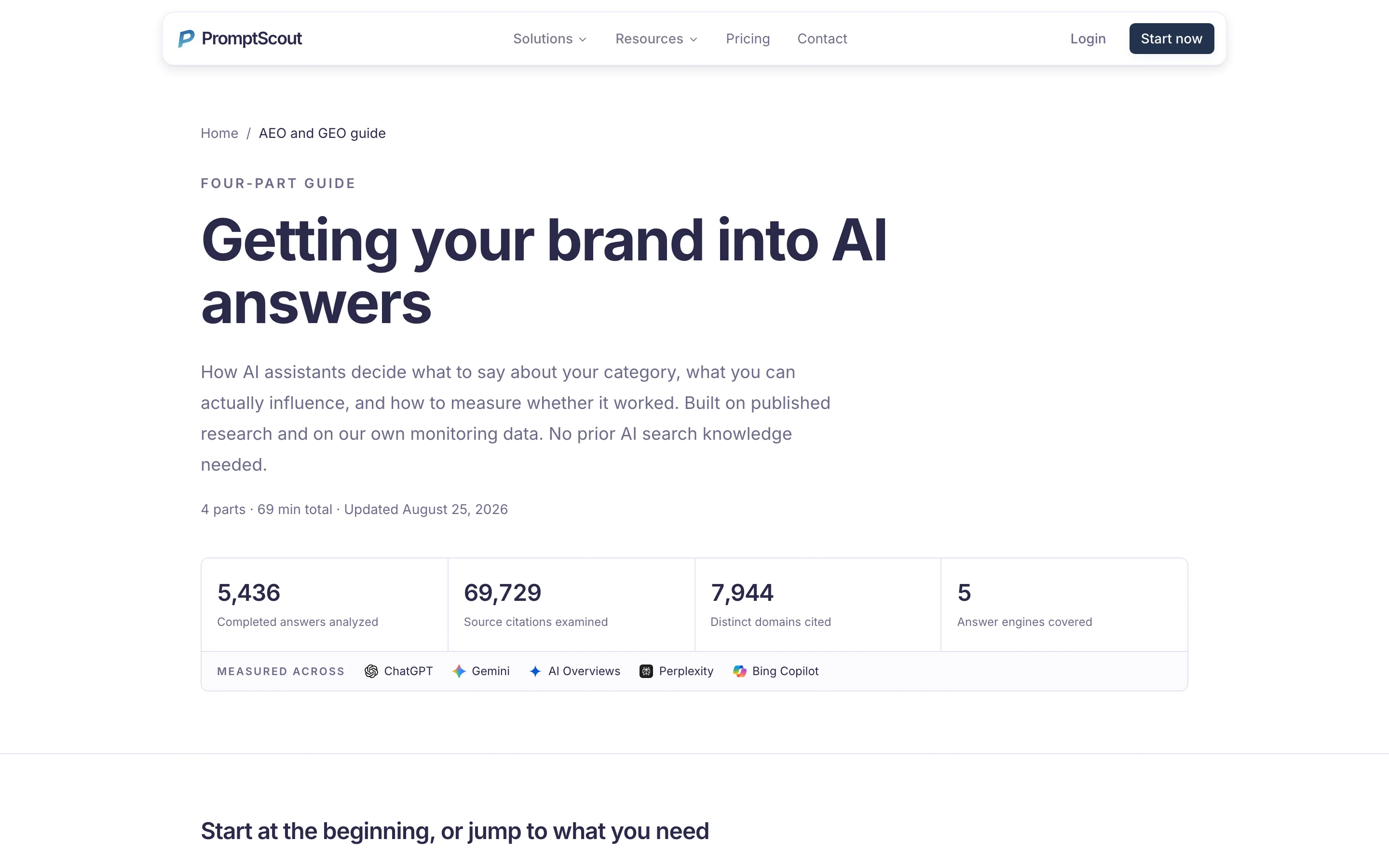
- Five charts built from 5,436 completed answers and 69,729 source citations across 7,944 distinct domains and five answer engines, aggregate-only.
- Every claim names its source and whether it is primary research, peer-reviewed, or a vendor study.
What the guide covers
Part 1 explains what actually happens between a question and an answer, and why the web did not stop mattering. Part 2 is the practical half: what makes a page retrievable, why a section has to answer on its own, and which off-site surfaces are worth your time. Part 3 is a four-week plan ordered by cost and certainty, cheap high-confidence work first. Part 4 covers measurement, including the difference between mentions and citations and why crawler access is the earliest signal you get.
Each part opens with a short quotable answer and closes with an FAQ, so a specific question can be answered without reading all 14,800 words.
The numbers are ours, and that matters
The five charts come from aggregate reads over 5,436 completed monitor answers and 69,729 source citations between May 28 and August 25, 2026, covering 7,944 distinct cited domains across ChatGPT, Gemini, AI Overviews, Perplexity, and Bing Copilot. No brand, customer, or URL-level data appears in the published figures.
The guide is also explicit about the limits of that panel. Ours is 135 tracked questions across a particular mix of B2B software and local service brands, and a different question mix produces a different source mix. Citation shares move sharply inside a single quarter. The point is not that our numbers are the right ones. It is that inheriting somebody else's average is a poor substitute for measuring your own questions.