
PromptScout Blog
GPT-6 Sol vs Luna: Uses, Pricing and AI Visibility
Compare GPT-6 Sol and Luna, their API pricing, practical marketing tasks, and Skills. Learn what to check when ChatGPT brand mentions and citations change.
Published

Founder
Building PromptScout to help teams understand how AI assistants cite, mention, and recommend their brands.
Your brand in AI answers
See where AI recommends your competitors.
Start with a free visibility check. Paid plans add monitoring; Growth adds Opportunities.
Paid monitoring: ChatGPT Gemini AI Overviews Perplexity Bing Copilot
GPT-6 Sol and Luna are OpenAI reasoning models for different workloads. Sol targets complex coding and tasks with several connected steps; Luna targets focused work repeated at scale. Marketing teams can use them to review product claims, classify saved AI answers, and identify gaps in content that buyers need.
Summary
Start with the task you want to improve. Sol is worth testing when a content brief depends on comparing conflicting sources. Luna is a cheaper starting point for organizing saved answers into categories. Test either model against examples your team has already reviewed, then check how much correction the output needs.
AI visibility means how a brand appears in AI answers: whether it is named, recommended, or linked as a source. Using a model internally and appearing in a buyer's ChatGPT answer are separate activities. To measure the latter, keep the original question and answer. Record brand wording and displayed citations separately, and compare the same questions over time.
How Sol and Luna differ
OpenAI positions Sol for complex coding and agent workflows, and Luna for focused tasks at higher volume. Both accept text and images and produce text. Developers can call them through an application programming interface, or API; built-in tools such as web search, file search, and Skills are available through the Responses API. The application must make those tools available for the task.
| Specification | Sol | Luna |
|---|---|---|
| Documented role | Complex coding and agent workflows | Focused work at high volume |
| Standard input price, per million tokens | $2.00 | $0.10 |
| Standard output price, per million tokens | $10.00 | $0.50 |
| Example marketing task to evaluate | Compare product claims across conflicting sources | Sort saved answers for manual review |
The models launched on September 22, 2026. Prices above apply to standard requests with up to 272,000 input tokens; larger requests, caching, processing options, and tool use can change the bill. These are API rates, not ChatGPT subscription prices.
For a small agency, the choice comes down to error cost as well as usage cost. A mislabeled answer is easy to catch when it includes the supporting sentence. An inaccurate product comparison can reach a client or a published page. Evaluate Sol for that harder review, and use Luna where the task has a clear definition and an output you can check quickly.
Prompts and Skills for content review
A useful review task names the material, the question, and the evidence the model must return. Give Sol the product pages and documentation you want compared, then ask:
Compare these pages against the attached product documentation. For each unsupported or outdated claim, quote the sentence, identify the relevant source, and suggest a correction. Mark unresolved conflicts for human review.
For Luna, a narrower task is easier to evaluate:
In each supplied answer, identify whether [brand] appears. Return the sentence containing the name and classify it as a recommendation, neutral description, or passing reference. If the brand is absent, record absent. Do not infer it from a related product name.
Review a sample of the classifications before using them in a client report.
An OpenAI Skill packages instructions and supporting resources for a repeatable task. You could put the claim-review procedure in a Skill alongside approved product terminology and a report format. That gives your team a consistent way to check pages.
What matters for ChatGPT visibility?
A model update can change how an answer is written, which products it includes, and which references it displays. Search settings, conversation history, and changes to the question can also affect the result. Keep those details with the answer before attributing a change to a model release.
For website owners, start with access and factual content. OpenAI documents OAI-SearchBot as its search crawler. Its setting is independent of GPTBot, which concerns potential model training. Review your search-crawler policy deliberately. Then check whether your product pages answer the question being asked: who the product serves, what it supports, what it costs, and where its limits are. Link claims to current documentation and give comparisons enough detail for a reader to verify them.
Track the answer at the right level. A brand mention names the company or product. A recommendation presents it as a choice for the user's need. A displayed citation links a page from the answer. OpenAI's web search documentation also distinguishes displayed citations from the fuller returned source list. Finding a URL in that list is a separate observation.
How ChatGPT citations can change
PromptScout's earlier Reddit citation study found that Reddit's share of visible ChatGPT citations fell from 13.05% to 0.45%, while its share of returned search candidates rose from 26.84% to 30.08%. Counting only returned URLs would have missed the decline in links readers could see.
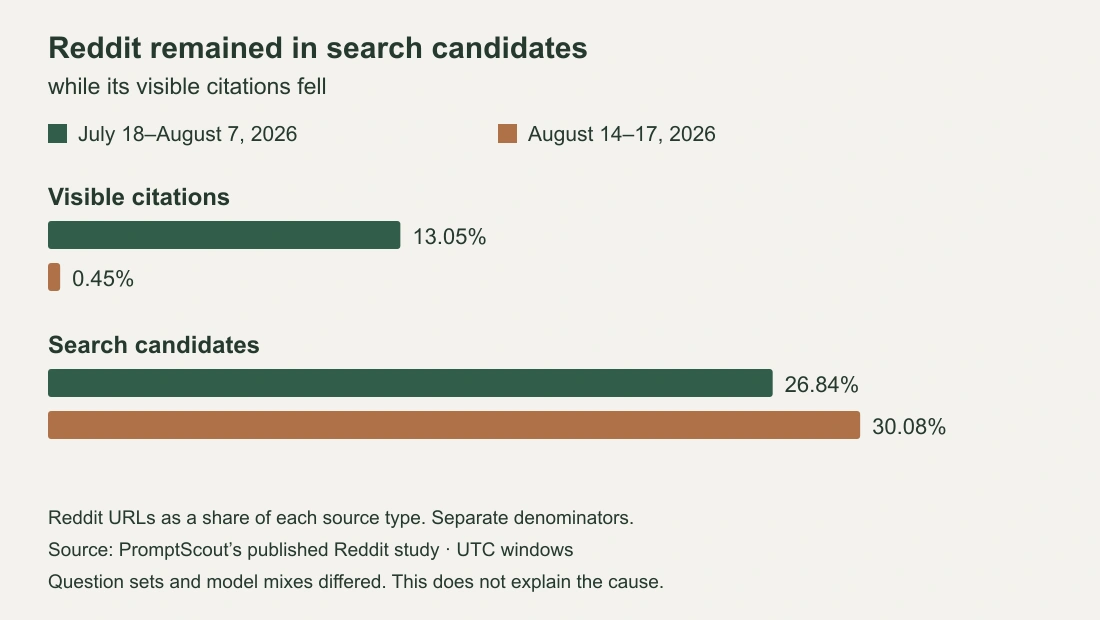
Reddit sources in ChatGPT answers across two earlier observation windows. Full sample details are in the linked study.
After a model update, look for changes like these in your own tracked questions. Does ChatGPT still recommend the same products? Does it cite a product page, a review, or a forum discussion? Has the reason for its recommendation changed? For the same appointment-software question, one answer might emphasize price while another emphasizes support for multiple locations. Save the wording and linked pages so you can see which product information needs attention.
ChatGPT comparison checklist
For a repair shop, an unbranded question could be: “Which appointment software works for a repair shop with two locations?” Keep that question in your comparison even if your brand is missing. Adding the brand name changes the test from discovery to a named-brand question.
| Keep with each answer | What it lets you check |
|---|---|
| Exact question and intent | Whether the comparison asks the same thing |
| Product, date, language, search state, and model when shown | Whether settings or context changed |
| Brand sentence and recommendation context | How the product was described |
| Displayed citations and returned URLs in separate fields | Which links readers saw |
| Completion or error status | Whether an absent brand was actually measured |
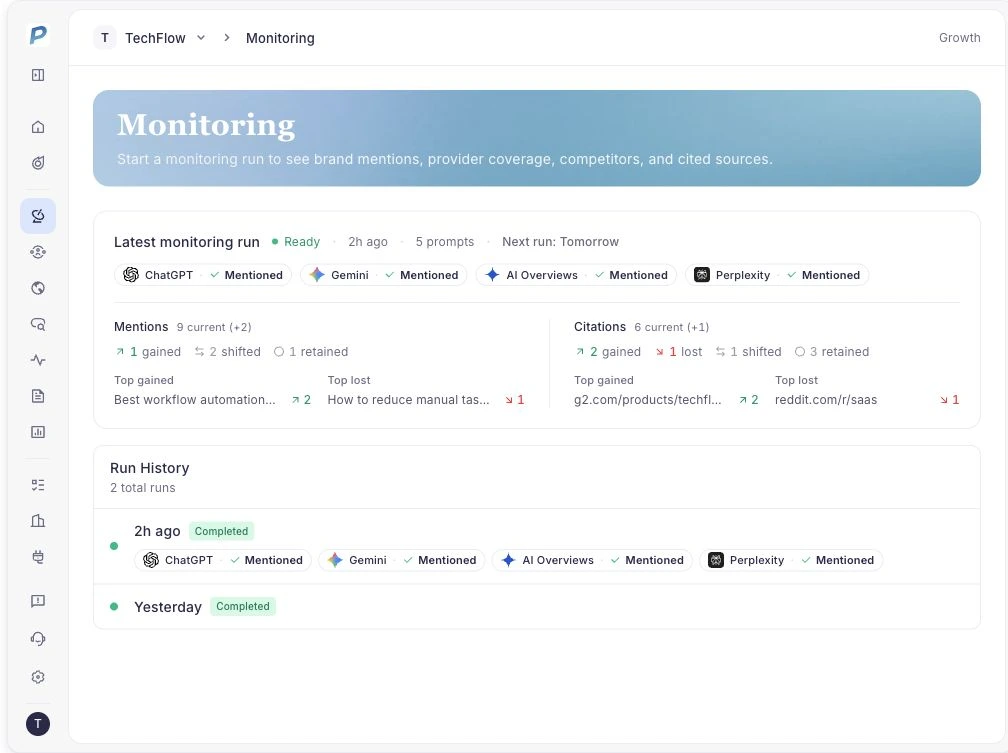
Public demo values in the Monitoring view.
Compare completed answers for the same question set. If a description becomes inaccurate, identify the claim and inspect its cited page before deciding what to edit. Keep a dated record of your page changes so the next review can distinguish a model announcement from your own content work. Several comparable runs give you a firmer basis for action than a single answer.
Using PromptScout
For ChatGPT monitoring, PromptScout does not substitute direct OpenAI model API responses for user-facing ChatGPT answers. API responses can differ from what buyers see in ChatGPT and give a misleading picture of brand visibility. Use Monitoring to review the tracked answers, then open Sources to inspect the linked pages. The provider is ChatGPT; label an answer Sol or Luna only if the captured information identifies that model.
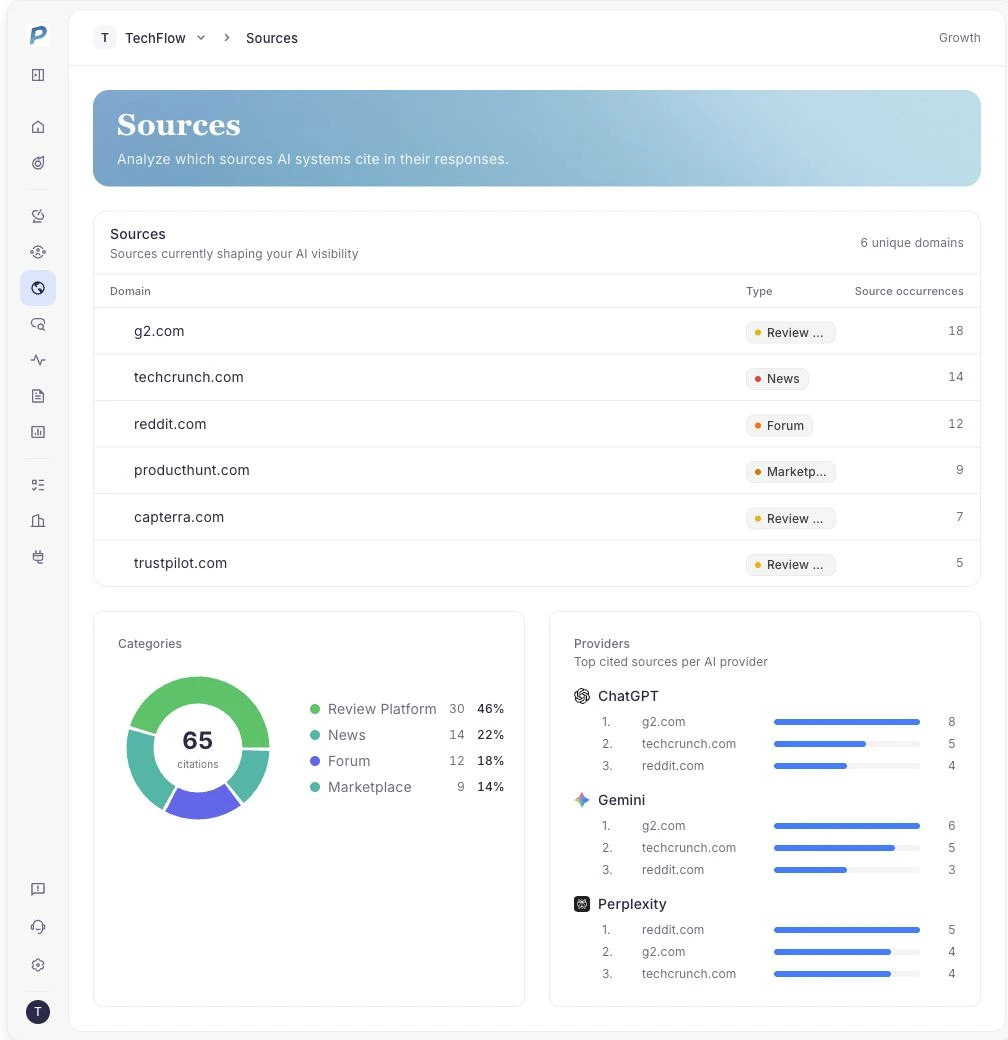
Public demo values in the Sources view.
Notes on the data
Model details and API prices were checked against OpenAI documentation on September 23, 2026. The chart comes from the Reddit citation study, covering July 18–August 7 and August 14–17, 2026, before Sol and Luna launched. It compares Reddit's share of displayed citations with its share of returned search candidates; question sets and model mixes differed. The linked study includes counts and methodology. Product screenshots show public demo values.