
GEO & AEO Tools to Improve AI Visibility
Find the pages and sources behind competitor recommendations, choose what to improve, and track later changes. PromptScout helps SEO and content teams work toward more qualified organic traffic with evidence-backed Opportunities and content briefs.
- No credit card required
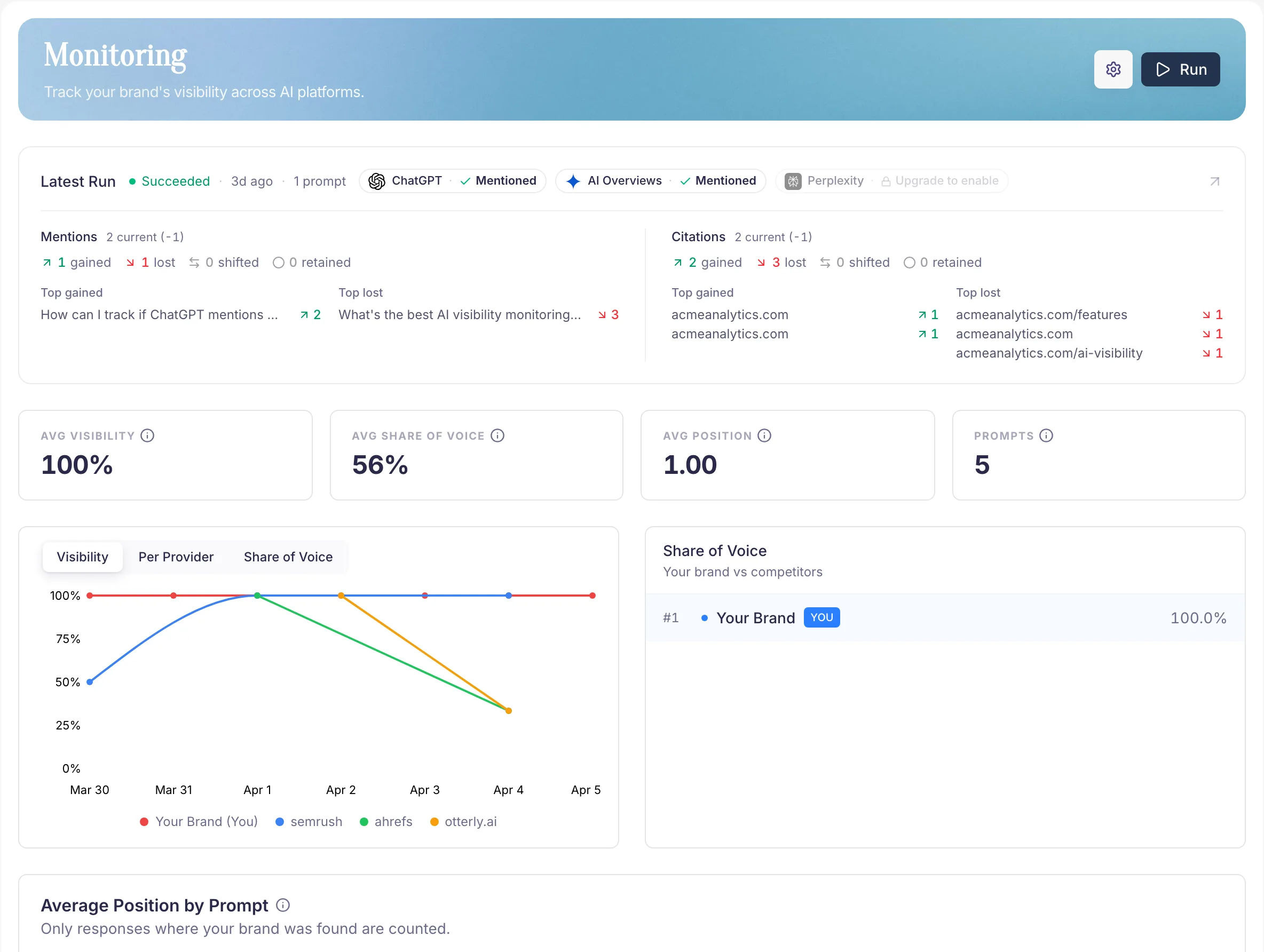
From Opportunity to content brief
Growth and higher · Opportunities beta.
Example workflow
Buyer question
Best workflow automation platform for SMB teams?
 ChatGPT
 Gemini
 AI Overviews
 Perplexity
 Bing CopilotNEW
Content gap
AI recommends Flowwise. TechFlow is missing a comparison page.
Example source
reviews.example/workflow-automation
“Flowwise is an option for SMB teams comparing workflow reporting tools.”
Illustrative source and excerpt.
SourcesContent Creationtechflow.io/compare/flowwise
Publish a TechFlow vs Flowwise comparison
Why nowHelp buyers compare the two products.
Content brief
Draft the comparison from your evidence. Review and publish with your team.
Track changes
Compare future answers, citations, and visits.
Buyer Checklist
Use these criteria to compare monitoring workflows before you commit budget or client reporting time.
| Decision point | PromptScout workflow | What to verify elsewhere |
|---|---|---|
| Generative answer coverage | Track buyer prompts across ChatGPT, Gemini, Google AI Overviews, Perplexity, and Bing Copilot on paid plans | Confirm the tool measures generated answers, not only search rankings or snippets |
| Citation and source review | Review cited URLs, domains, and source categories behind each answer | Look for source evidence supporting a specific content decision |
| Competitor answer tracking | Compare competitor appearances on the same prompt set and provider mix | Avoid workflows that cannot separate brand mentions from competitive context |
| Reporting workflow | Use recurring monitoring and reports to show what changed over time | Check whether outputs support repeated review instead of one-off audits |
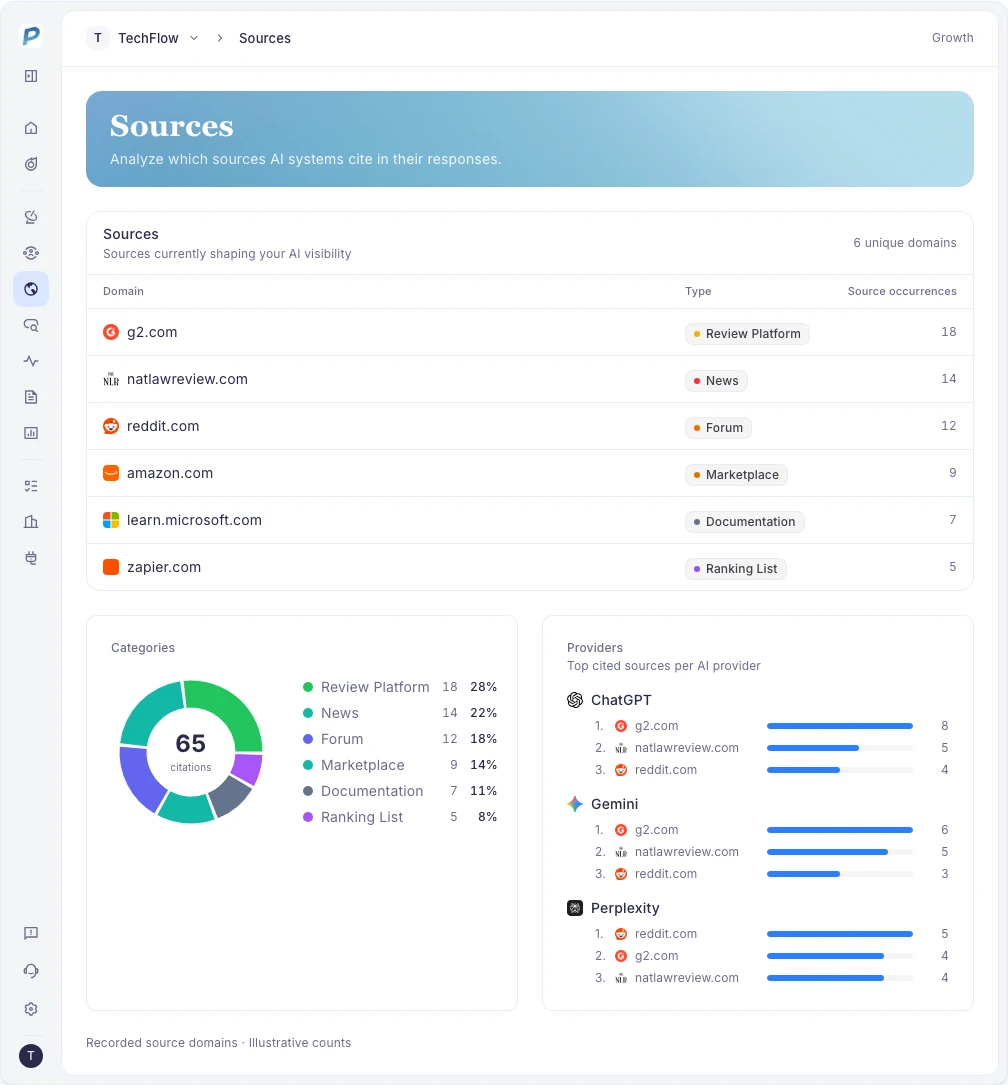
Find where competitors get recommended
PromptScout gives SEO and content teams a starting point for improvement: the buyer question, the brands named in the answer, and the pages it cites. Paid monitoring covers ChatGPT, Gemini, Google AI Overviews, Perplexity, and Bing Copilot on your plan's schedule.
- Compare brands on the same buyer questions
- Inspect cited URLs before deciding which page to improve
- Keep provider and prompt context beside each observation
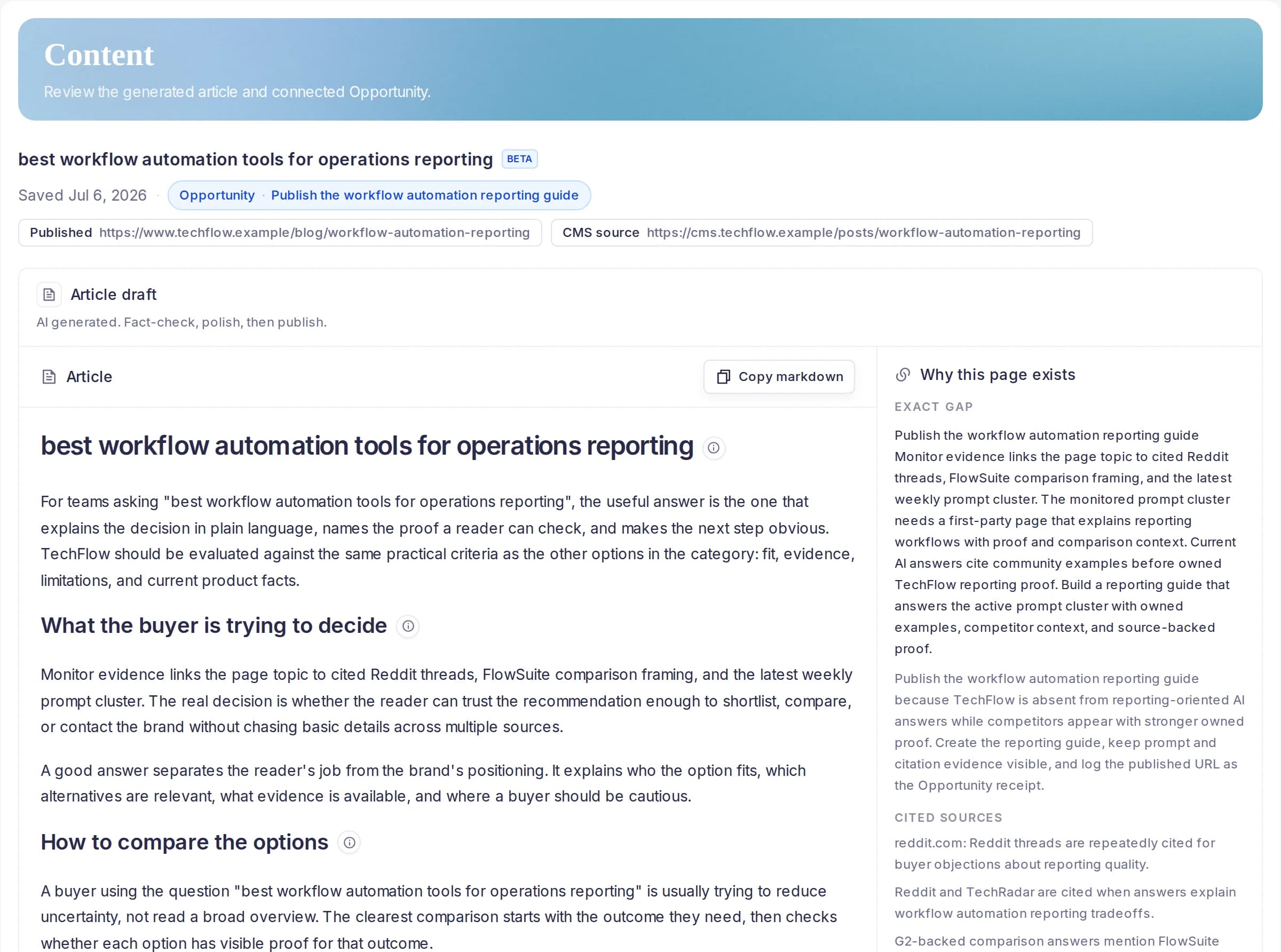
Turn a gap into a focused content brief
Growth and higher add Opportunities (beta): scoped actions with source evidence, a target, and completion notes. Eligible content and comparison Opportunities can become a content brief when the required monitoring and site evidence is available. Your team reviews, edits, and publishes the work.
- Choose the page or source worth improving
- Build a brief from the Opportunity's questions and evidence
- Return to later scheduled results to observe what changed
Start free, then choose the workflow you need
The free visibility check prepares three buyer questions from your website. Signup is required before three OpenAI answers run and the result is saved. Starter begins at $15/month for ongoing monitoring. Growth and higher add Opportunities, related briefs, and connected Google/Bing Search data; Traffic is beta. Agency access depends on the package.
Evaluate GEO and AEO tools together
Generative engine optimization (GEO) and answer engine optimization (AEO) are overlapping industry labels for improving visibility in AI answers. Vendors use both for monitoring, source analysis, and content guidance. Evaluate the actual workflow, provider coverage, and plan boundaries rather than treating AEO as only snippets or FAQs.
- Begin with buyer questions and someone who can publish changes
- Check that recommendations include sources and a specific next action
- Keep SEO fundamentals: Google requires no special AI markup
- Measure mentions, citations, search clicks, and referrals separately; none guarantees growth
Related Guides
Explore these guides to learn more about AI visibility, optimization strategies, and best practices.
The AEO and GEO Guide
A four-part guide to how AI answers choose sources, what you can influence, and how to measure it, with first-party monitoring data.
Read guide
AI Monitoring Tools Comparison
Compare AI monitoring tools by provider coverage, prompt workflows, competitor tracking, and reporting fit.
Explore feature
AEO and SEO Comparison
Understand how AI SEO differs from traditional SEO workflows.
Read guide
AI Visibility Blog Guides
Practical AEO, GEO, and AI visibility guides for teams improving AI search performance.
Read guide
AI Visibility Improvement Workflow
Actionable playbook for improving recommendations across AI assistants.
Read guide
PromptScout for Agencies
Package multi-brand AI visibility monitoring for client reporting across supported providers.
See pricing or create account
Frequently Asked Questions
How are GEO tools different from AEO tools?
GEO and AEO tools overlap: both can monitor AI answers, compare competitors, inspect citations, and guide content work. Compare documented capabilities rather than the acronym.
What should a GEO tool measure first?
Start with recurring buyer prompts, generated answer coverage, cited sources, competitor mentions, and provider-level differences across the AI surfaces your buyers use.
Should GEO tools and AEO tools be evaluated together?
Yes. Evaluate provider coverage, source evidence, improvement workflows, and plan limits together. Neither label guarantees rankings, citations, or traffic.
Related Features
GEO vs AEO
Compare GEO and AEO with clear definitions, prompt examples, measurement rows, and PromptScout workflows for provider-specific AI visibility.
Explore GEO vs AEOAI Monitoring Tools Compared
Compare AI brand monitoring tools by provider coverage, prompt workflows, competitor tracking, citations, Opportunities, content briefs, and proof.
Explore AI Monitoring Tools ComparedAI Citation & Source Tracking
Inspect source URLs, displayed citations, recurring domains, and page types in monitored AI answers. Review brand context with PromptScout, starting on Starter.
Explore AI Citation & Source Tracking