
PromptScout Blog
Do More Pages on a Topic Mean More AI Citations?
See when a website appears among AI answer sources, what that does and does not say about citations, and how to decide whether another page is worth writing.
Published

Founder
Building PromptScout to help teams understand how AI assistants cite, mention, and recommend their brands.
Your brand in AI answers
See where AI recommends your competitors.
Start with a free visibility check. Paid plans add monitoring; Growth adds Opportunities.
Paid monitoring: ChatGPT Gemini AI Overviews Perplexity Bing Copilot
Publishing more pages does not guarantee more AI citations. First, find the buyer questions your existing pages should answer. Then check whether AI tools use those pages as sources and whether they show the links to readers. Write a new page only when you find a real question your current site does not answer well.
Summary
Page count and AI visibility answer different questions. A site can cover a topic thoroughly yet be absent from the sources behind an AI answer. One strong page can also serve several buyer questions. Count the questions your pages answer and the questions where your website appears in AI results before planning more content.
Our monitoring data offers a starting point. We tracked 62 cases, each pairing one brand with one buyer question. The brand's website appeared among the sources saved with an AI answer for 39 cases at least once. It did not appear for the other 23. That is a source signal, not a count of citations people saw. It points to questions worth reviewing; it cannot tell us whether publishing another page would help.
Start with the buyer's question
Imagine a scheduling company whose buyers ask, “Can this tool handle recurring appointments at two locations?” Its product page may already answer that well. A second page with a similar title would add little for the reader. If the page omits a key condition, such as how staff calendars work across locations, improving it may be the better task.
Now take a different question: “Which scheduling tool should a two-location repair shop choose?” That asks for a comparison. The company may need a useful comparison or customer example, rather than another feature page. The content decision starts with the buyer's need, not a target number of pages.
Wellows' September 2026 research found that websites cited for more questions within a topic also tended to be cited for other questions in that topic. The study did not test a campaign that published more pages. It measured where citations appeared during the same period, so it cannot show that page volume caused them. That is why a page-count target is a weak substitute for checking real questions and sources.
What our source data shows
Our monitoring record saves website URLs associated with each completed AI answer. We call these recorded sources here. A citation is a link the AI answer actually shows to a reader. A recorded source may not be a visible citation. Our source and citation guide shows how to tell them apart in an answer.
We looked at a recent, anonymized monitoring sample. For each brand and buyer question, we asked a simple question: did the brand's website appear among the recorded sources at least once? We combined observations from ChatGPT, Gemini, Google AI Overviews, Perplexity, and Bing Copilot. The chart counts each brand-and-question combination once, even when we checked it several times or on several tools.
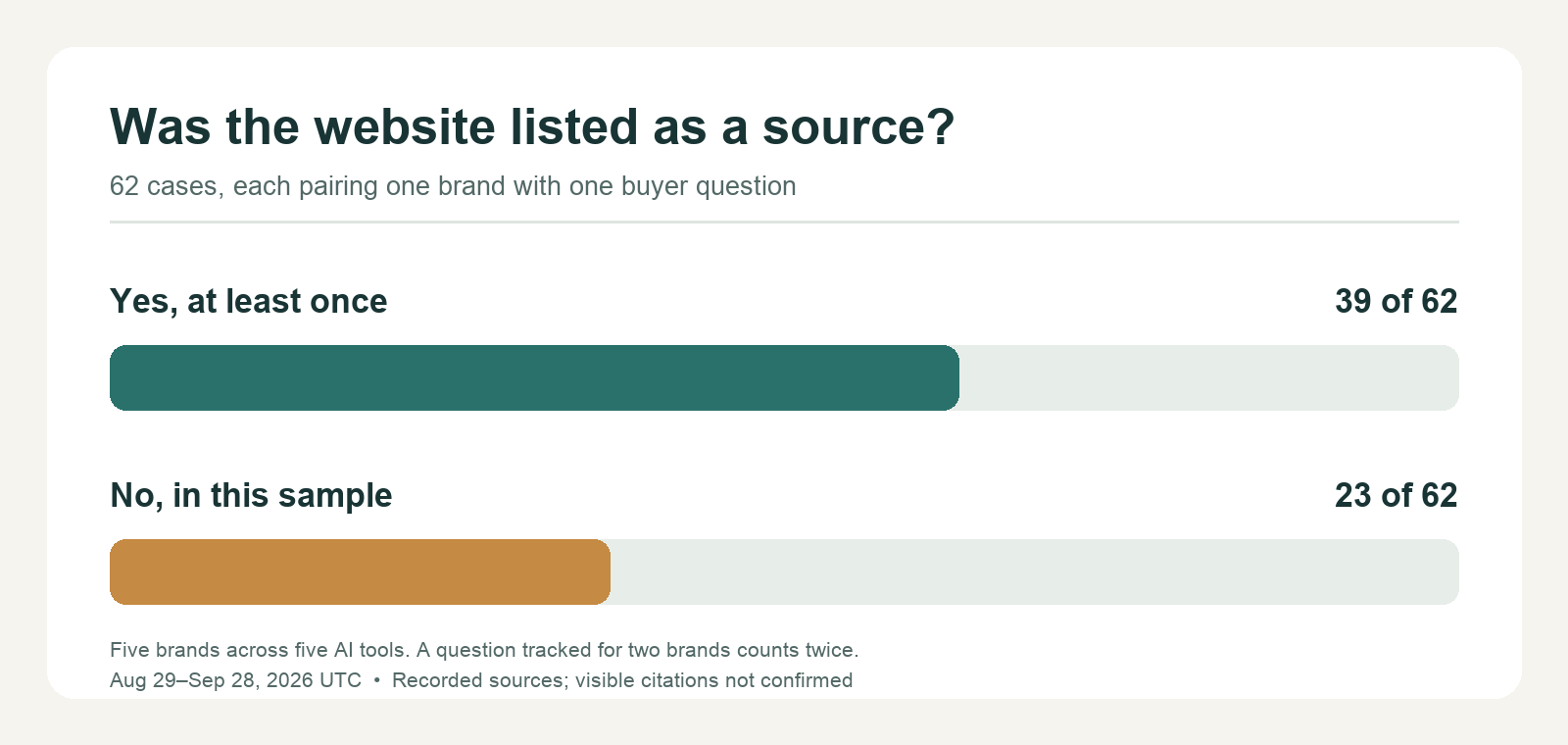
How to read this: “Yes” means the website appeared among recorded sources at least once during August 29–September 28, 2026 UTC. “No” means it did not appear in this sample. The chart does not measure how many pages the brands published or how many links people saw.
The 23 questions without a website source are places to investigate, not instructions to write 23 pages. Open the answers. See which other pages appear and whether your current page answers the question clearly. Our guide to source gaps and content gaps helps with that first diagnosis.
Check whether the result repeats
One appearance can be misleading. The same question may produce different sources on later checks. ChatGPT makes that pattern easy to see in this sample because all 62 monitored brand questions had more than one completed answer there.
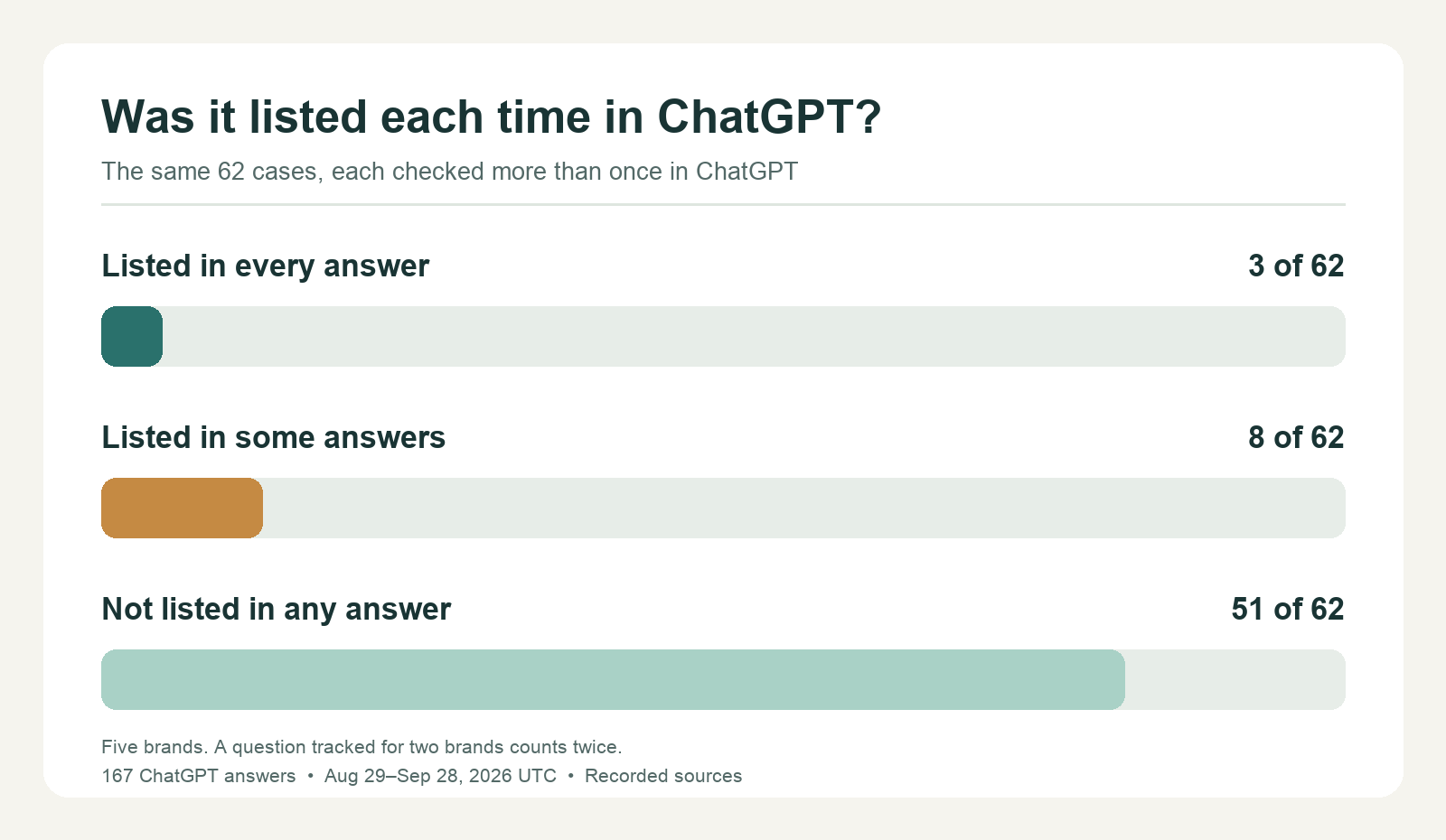
How to read this: for each question, we checked whether the brand's website appeared among ChatGPT's recorded sources in every answer, only some answers, or none. The chart covers 167 completed ChatGPT answers from five brands during August 29–September 28, 2026 UTC. It does not count visible citations.
The website appeared at least once for 11 of those questions, but only three showed it every time. If you see your page once, save that answer and check the question again before calling it a steady result. A changing source list does not explain why it changed. The answer, the page, and the other sources still need a human review.
These charts answer different questions. The first asks whether a website appeared at least once in any monitored tool. The second asks whether that appearance repeated in ChatGPT. They are not an engine leaderboard. They do not measure citation rate, referral visits, or the effect of a content change.
Page decision checklist
For a small agency or founder, the useful next step is a small group of buyer questions. For each one, read the AI answer and the page on your site that should help. Then make a specific decision:
- The page answers the question, but your website is absent. Check whether the page is accessible and current. Read the competing sources. Do not assume a duplicate page will solve the gap.
- The page gives an incomplete answer. Add the missing detail, conditions, and evidence to that page. Record what you changed and when.
- No page serves the buyer's question. Create a page only if the question represents a distinct need that deserves its own useful answer.
After a change, check the same questions again. Record brand mentions, visible citation links, and recorded sources separately. Compare several completed answers, not just the first favorable one. A later citation may be encouraging, but the before-and-after observation alone cannot prove what caused it. Google's guidance for AI features also starts with ordinary Search eligibility and useful, accessible content; it does not promise a citation from a particular page format.
Using PromptScout
In PromptScout, group the buyer questions in Prompts. Review completed answers in Monitoring, then inspect the associated pages in Sources. Open the answer itself to check whether it shows a link and how it describes the brand. Save the question, provider, date, page URL, and what you changed on the page.
PromptScout currently supports ChatGPT, Gemini, Google AI Overviews, Perplexity, and Bing Copilot. Check results by provider rather than treating them as one answer. Direct OpenAI model API responses can differ from user-facing ChatGPT answers, so they cannot stand in for a ChatGPT visibility check.
Notes on the data
These charts use anonymized production monitoring from August 29 through September 28, 2026 UTC. The sample has 763 completed answers with finished brand-mention processing, 62 distinct brand-and-question combinations, and five monitored brands. We counted a website when a recorded source URL matched the monitored brand's website domain exactly after removing www. Multiple matching URLs in one answer count once. The first chart combines all five supported providers. The second uses 167 ChatGPT answers for the same 62 combinations; each had at least two completed checks.
The brands and questions are a selected monitoring sample, not a market benchmark. Source fields differ across providers. In particular, no matching website URL appeared in the Google AI Overviews source field in this sample; that does not establish that its displayed answers lacked a link. Neither chart counts published pages, verified visible citations, recommendations, visits, or changes caused by publishing.
Wellows analyzed 9,471 English-language questions in 151 topics and 382,176 answer observations collected January–June 2026. Its citation analysis and our recorded-source analysis measure different things and use different samples. We do not combine their figures into one result.