
PromptScout Blog
Gemini 4 Argon: Capabilities, Uses and AI Visibility
Understand Gemini 4 Argon, compare its capabilities with OpenAI and Claude models, and see what our Google AI Overviews data means for brand monitoring.
Published

Founder
Building PromptScout to help teams understand how AI assistants cite, mention, and recommend their brands.
Your brand in AI answers
See where AI recommends your competitors.
Start with a free visibility check. Paid plans add monitoring; Growth adds Opportunities.
Paid monitoring: ChatGPT Gemini AI Overviews Perplexity Bing Copilot
Gemini 4 Argon is Google's new reasoning model for complex work across software, documents, visual analysis and cybersecurity. Its main advances are stronger performance on demanding professional tasks and more room to work through long problems. For marketers, that makes it relevant to research and content review, while AI visibility still depends on the answers and sources people actually see.
Summary
Argon is designed to sustain work across connected steps: inspect material, reason about it, use tools and produce a result. Google is already using it internally and giving trusted cybersecurity partners early access. The broader rollout will begin with paid API customers and Google AI Ultra subscribers.
For a founder or small agency, the useful applications are specific: checking product claims against documentation, comparing conflicting sources, analyzing reports and building or repairing software. Evaluate a model on work you can review. For brand visibility, track the buyer's question, the brand wording and the sources separately. An improved research assistant and an improved presence in Google Search require different evidence.
What kind of model is Argon?
A model is the system that interprets your input and generates a response. An assistant is the product around it, with an interface, tools and account settings. Argon belongs to Google's Gemini family. ChatGPT is OpenAI's assistant; Claude is Anthropic's assistant and model family. They compete on similar work, but Argon does not power ChatGPT or Claude.
Reasoning models are built to work through difficult problems before delivering an answer. In an agent workflow, the model also uses tools and continues through a sequence of actions. That suits a task such as inspecting a report, finding inconsistent claims, checking their sources and preparing corrections for review.
Google announced Argon on September 30, 2026. Its first rollout is through the Fairwind program for trusted cyber defenders. That access reflects a concrete use case: finding, validating and patching software vulnerabilities. The same announcement describes strengths in financial research, legal drafting, coding and creative writing.
Where the capabilities improve
Google expands the output limit to one million tokens, compared with its previous 64,000-token limit. Tokens are pieces of text the model processes or generates; a larger output allowance gives it more room for reasoning and a substantial deliverable. This is an output limit, not the size of the documents you can upload. For comparison, GPT-6.1 Sol's specification lists a maximum output of 128,000 tokens.
The Vals Index provides a separate comparison across finance, coding, legal and tax tasks. It weights those sectors by their share of the US economy. Its September 30 snapshot lists these selected results:
| Model | Vals Index accuracy |
|---|---|
| Gemini 4 Argon | 68.90% |
| Claude Sonnet 5.5 | 67.04% |
| Claude Opus 5.5 | 66.97% |
| GPT-6 Astra | 63.13% |
| GPT-6.1 Sol | 61.15% |
| Gemini 3.8 Flash | 54.83% |
GDP-weighted benchmark accuracy, not a marketing performance score. Vals documents the task mix and evaluation settings; its published Claude results include fallback runs after provider refusals.
Argon's higher result is a reason to evaluate it for demanding professional work. For content review, judge factual accuracy and correction time on your own material. Google also reports leading results in software engineering and long-video understanding. Those capabilities make document-heavy research and visual review useful tasks for a first evaluation.
How it compares with ChatGPT and Claude
The practical comparison is between a model, the product offering it and the task you need done. OpenAI positions GPT-6.1 Sol for complex work at lower cost than Astra. Its current availability documentation places Sol in ChatGPT Work and OpenAI's coding assistant, rather than Chat. Anthropic offers Opus 5.5 in Claude and through its developer platform for coding and knowledge work.
If you already use ChatGPT or Claude, keep a task your team has reviewed and compare the result when Argon becomes available to your account. Use the same source documents and requested output. Record factual errors, missing conditions, correction time and total task cost. That is more useful than choosing solely by a leaderboard. Our guides to Sol and Luna and Claude Opus show how to frame a claim-review task.
A checklist for model evaluation
For a software founder, a good evaluation is a comparison page checked against current product documentation. Ask the model to quote each disputed sentence, link the supporting document and propose a correction. For an agency, supply a campaign report and its underlying figures, then ask it to separate measured results from explanations that still need evidence.
Visual understanding also makes a presentation or recorded product walkthrough a useful test. Ask for the product claims made in the material and where they appear. A human reviewer can check each claim before it enters public copy.
Use this checklist for the first evaluation:
- Choose a recurring task with a result your team can check.
- Supply the authoritative documents and define the deliverable.
- Require a source for each factual correction.
- Compare the corrections needed with your current workflow.
- Keep publishing and changes to customer-facing systems under human review.
What this means for AI Overviews
Google Search uses models alongside search and source-selection systems. Google's site-owner guidance says AI Overviews and AI Mode can search across related subtopics to assemble an answer. They may use different models and techniques. The established work for a business is to publish useful, accurate pages that Google can index and show with a snippet. The Argon announcement concerns a model rollout; it does not announce a change to these Search requirements.
Our own Google AI Overviews observations show why source presence and brand presence deserve separate checks. In the September sample, 152 answers had saved source URLs. The tracked brand's name was detected in 49 of those answers; it was not detected in 103.
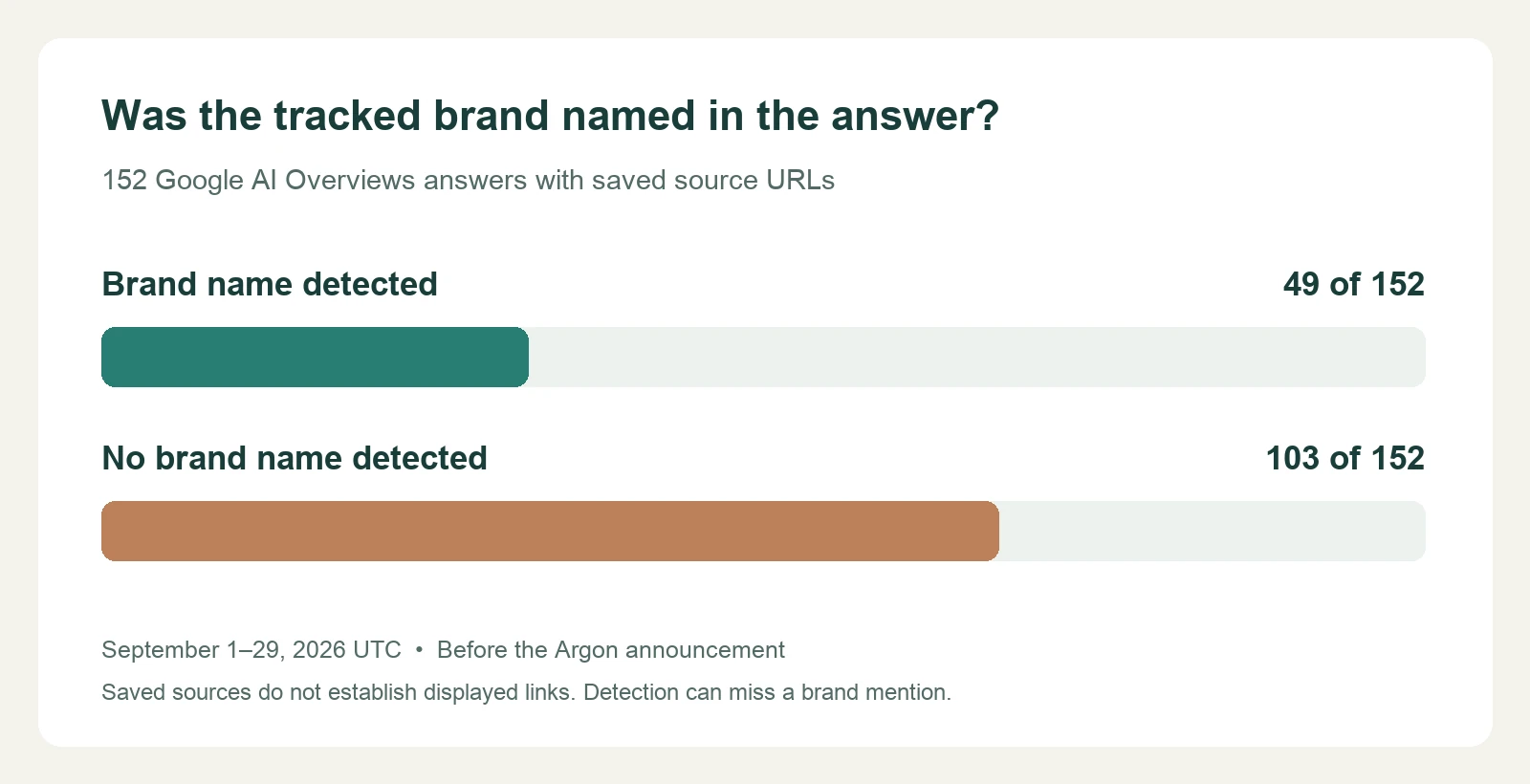
Answers with saved source URLs, September 1–29, 2026 UTC. Saved sources do not establish where a link appeared on screen. This sample predates the Argon announcement.
The useful action is to inspect the answer's wording as well as its sources. If a buyer asks for software suited to a repair shop, check whether the answer names your product, describes its relevant features accurately and presents it as a suitable choice. Then inspect the supporting pages. A source list alone cannot answer those questions. See our AI Overviews link-measurement guide for the difference between source presence, displayed links and visits.
For ChatGPT, review the user-facing answer itself. A direct OpenAI API response can differ because the model, tools and conversation context differ. Keep each surface identified in the record instead of treating the API response as a substitute.
Using PromptScout
Use PromptScout's Monitoring view to review finished runs and compare answers to the same questions. Open Sources to inspect recurring pages and compare them with the answer's brand wording. Keep a separate note of public model announcements and your own content changes so you can review their dates alongside observations. Supported monitoring covers ChatGPT, Gemini, Google AI Overviews, Perplexity and Bing Copilot. Review Claude separately when it matters to your audience.
Notes on the data
The PromptScout sample contains 154 completed Google AI Overviews answers for 61 monitored questions across four tracked brands, recorded September 1–29, 2026 UTC. It includes successful answers with completed brand analysis; failed records, unfinished analysis and no-overview responses are excluded. Brand detection required evidence of the name in answer text. These are selected monitoring questions, not a market-wide sample, and detection can miss a mention. The chart uses the 152 answers with saved sources as its denominator. It measures neither Argon's effects nor referrals.