
What should I compare when choosing AI visibility monitoring software?
Judge a tool by two things: the evidence it keeps, and whether that evidence turns into work. Run a small pilot a colleague could repeat without asking you how.
Published by PromptScout · Updated August 25, 2026
Provider coverage
 ChatGPT
 Gemini
 AI Overviews
 Perplexity
 Bing CopilotNEW
TL;DR
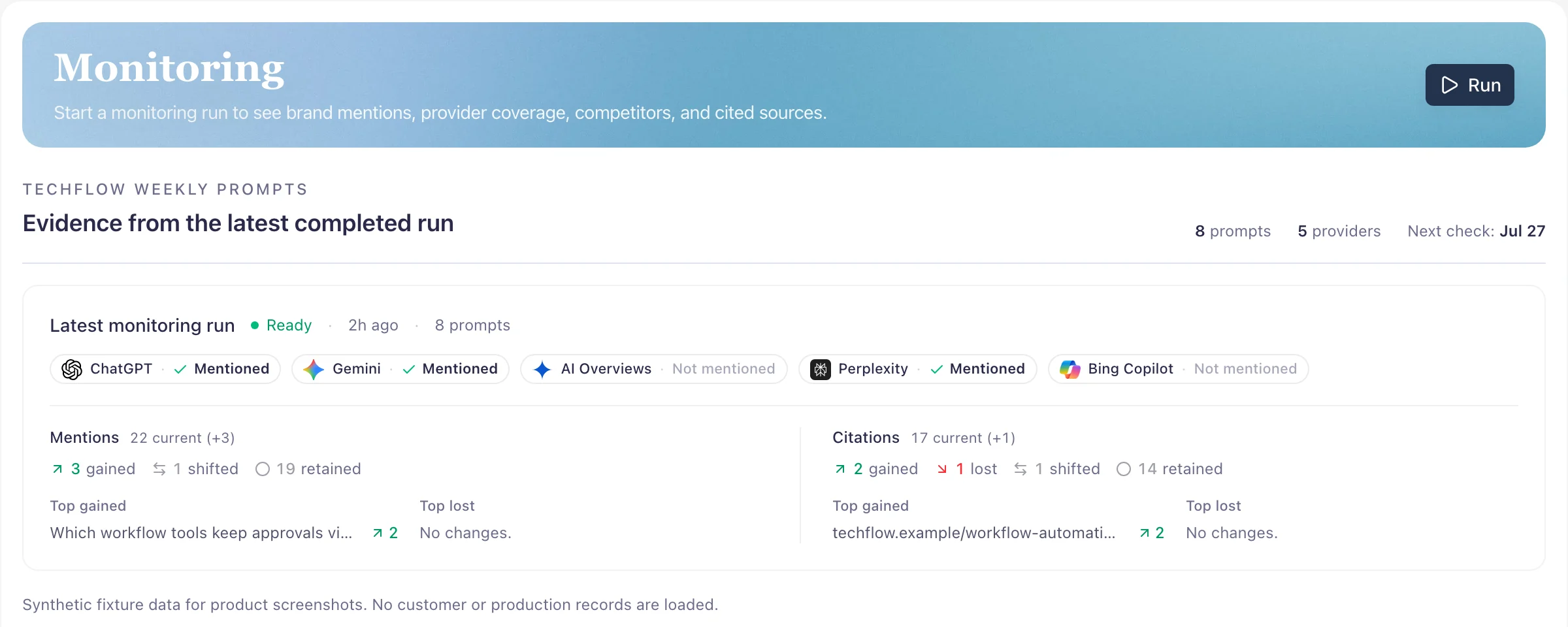
Choose a tool that reruns the same buyer questions across the providers you care about, keeps the answer and citation context, and turns a repeated gap into work someone can finish. PromptScout fits when you need evidence for each provider linked to Sources, Competitors, and Opportunities rather than one blended score.
01
Start with buyer questions you can repeat
Start with the questions your buyers ask out loud, not your category name. Twenty is plenty: a few category questions, a few comparisons, a pricing question, and a couple of problem questions like "how do I stop losing renewals to churn." Decide once which providers, locations, and languages count, and how often the set runs. Then leave all of it alone, because a set that quietly changes cannot produce a trend. Every result should carry its prompt, provider, run date, and the answer itself, so anyone can check a finding a month later. What you end up with is a sample of the market rather than a census, and that is fine as long as you say so.
02
Read the answer, not only the score
A score is a lead. The evidence is the answer text. Open five prompts, read what the engine actually said, and follow every cited link to see whether the source really supports the claim. You will find pages that were cited for one clause and pages that were cited for nothing at all. If your colleague cannot reach the same conclusion from the saved answers and links, the number is not usable. Two caveats worth holding onto: citations move between runs, and a citation never proves that a source caused the recommendation.
03
Turn a repeated gap into one opportunity
A comparison that ends in a dashboard has not finished. Take one gap that shows up run after run, such as a competitor named where you are not or a review site cited every time, and turn it into a single job: one page or channel to change, one person who owns it, and one way to tell whether it is done. Agree in advance which prompts you will watch afterwards, and for how long. Ask every vendor to show you that handoff rather than describe it. Software can organize the evidence; it cannot publish the page or promise you a mention.
04
Make the two-run pilot comparable
Two dated runs of the same ten prompts will tell you more than a month of demos. Freeze the prompts, the providers, and the scoring rules, run them twice, and compare the two runs before you expand anything. Answers move on their own between runs, so a single round cannot separate a real difference between tools from ordinary variation.
Only then look at the commercial terms: how many runs you get, how long history is kept, whether you can export, how many seats you need, and how you cancel. And when you compare scores, compare the definitions behind them. Nobody has standardized what a visibility score means, so two vendors can report very different numbers from the same answers simply by counting a different denominator.
Scope and limitation
AI answers vary by provider, prompt, retrieval context, location, and run time. Treat a monitoring tool as a report of an observed cohort. It does not control provider output, replace SEO or content execution, or prove that one change caused later visibility movement.
Start with your own prompt evidence
Set up the questions that matter to your buyers, then compare the same evidence over time.