
SaaS stack guide
What are the best AI SEO tools for SaaS companies?
Build the stack around the bottleneck. Search performance, SEO research, content optimization, and AI-answer visibility solve different jobs.
Published by PromptScout · Updated September 12, 2026
Provider coverage
 ChatGPT
 Gemini
 AI Overviews
 Perplexity
TL;DR
Usually, a SaaS team needs three layers, not one best tool: Google Search Console plus Semrush or Ahrefs for search performance and SEO research; Surfer or Clearscope when content optimization is the bottleneck; and PromptScout when buyer-question visibility in AI answers is a measurable channel. Start with the smallest stack that closes your current evidence gap, then connect the outputs to one page decision.
Three layers, four jobs
PromptScout publishes this guide and is one of the products discussed. This is a comparison of documented capabilities, not an independent hands-on ranking. Each row names a job, a source and a limit so you can evaluate the capability you need. Check current plans and limits before buying; the rows do not establish which product will improve your results.
| Tool | Documented benchmark surface | Pilot boundary to check | First-party source |
|---|---|---|---|
| Search performance | Search Console's Performance report shows first-party clicks, impressions, click-through rate, and average position for Search results. | Use it for owned Search performance. It does not explain generated answers from individual AI providers. | |
| Traditional SEO research: Semrush | Semrush documents Keyword Magic for research, Position Tracking for rankings, and Site Audit for crawl findings. | Check database country, device and location scope, crawl settings, exports, and metric definitions. | |
| Traditional SEO research: Ahrefs | Ahrefs documents product, Site Explorer, and Site Audit surfaces for SEO research, competitors, backlinks, and crawl findings. | Check country, device and location scope, backlink coverage, crawl settings, exports, and metric definitions. | |
| Content optimization: Surfer | Surfer documents Content Editor guidance and a Content Score for drafting and refreshing pages. | Treat the score as guidance. Check editorial quality, search intent, published-page performance, and maintenance time. | |
| Content optimization: Clearscope | Clearscope documents Content Reports, Editor guidance, and Content Inventory for drafting and refreshing pages. | Treat recommendations as guidance. Check editorial quality, search intent, published-page performance, and inventory maintenance time. | |
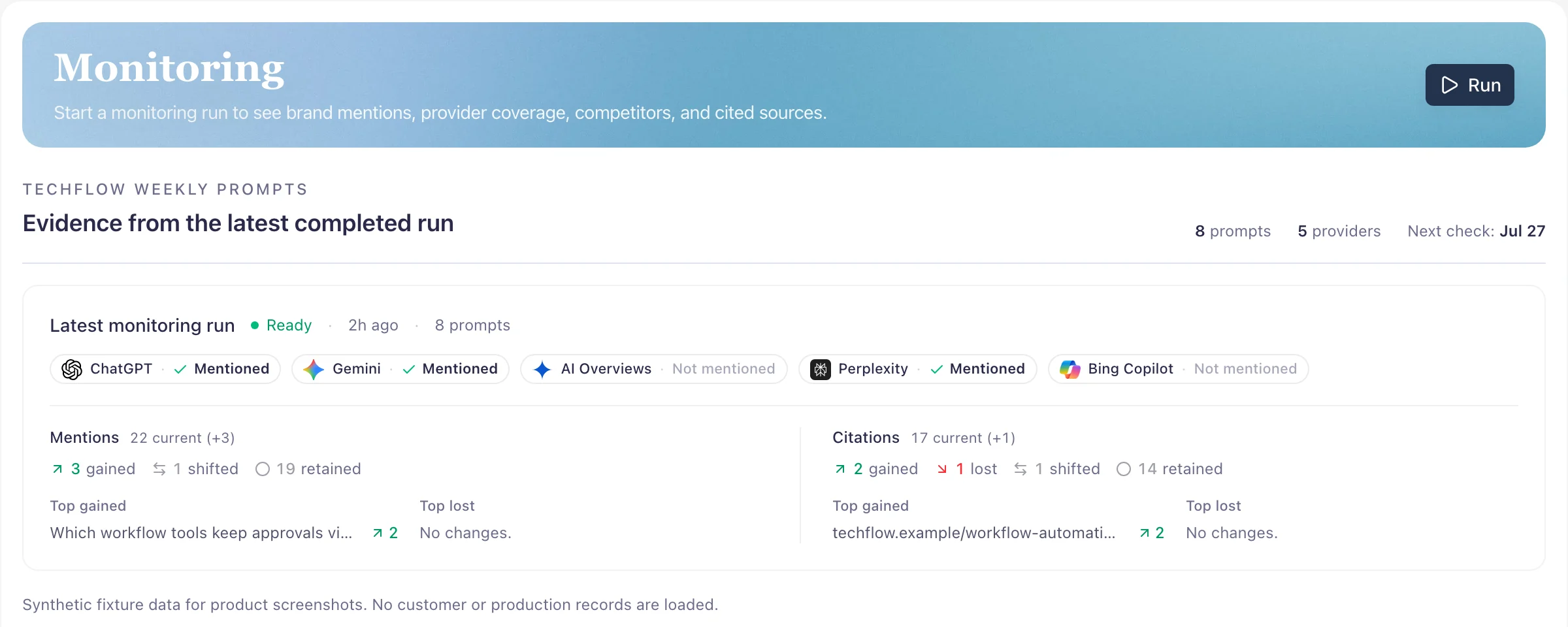
| AI-answer visibility | PromptScout documents recurring provider monitoring, competitor and source evidence, and a weekly evidence-to-action workflow. | Use it for monitored AI answers. It does not replace keyword volume, backlinks, technical SEO, rankings, or traffic reporting. |
01
Choose for your team's next decision
A solo founder with a small budget should start by naming the unanswered question: which existing page attracts relevant searches, which draft needs better evidence, or what assistants say about the product? Use the search data you already have before paying for another overlapping report. If AI answers are the gap, compare the providers, prompt allowance and review time you need against the current plan.
A SaaS content team can test editing guidance on an existing page with a clear reader question. An agency needs to evaluate brand separation and how it will explain evidence to each client. These are illustrative buying situations, not claims that one stack fits every team. The next step is a scoped evaluation, not a separate subscription for every row.
02
Start with first-party search performance
Open Search Console, pick one page and one topic, and record clicks, impressions, click-through rate and average position over a stated date range. Save the baseline before editing. Separate queries containing your brand, product names and common spelling variants from the remaining queries, and record the filter you used so later comparisons use the same definition.
Non-branded clicks help assess discovery beyond brand-name searches, but they do not prove that every visitor is new. Branded discovery and conversions still matter. Query reporting omits some data for privacy and other reporting limits, so a filtered total is not complete demand coverage. Keep organic search results separate from AI referrals and the answers your monitor records.
03
Use SEO research for demand and technical work
When the question is how much demand exists, who ranks for it, or why a page is not being crawled, this is the layer that answers it. Semrush and Ahrefs both do the job; pick one and learn it properly rather than half-using two.
Whatever you hand to a writer or a developer should name the specific query, the specific page, the specific issue, and where the number came from. "Improve our SEO" is not a brief. And to be clear about the boundary: an AI visibility tool does not replace keyword volume, backlink data, technical crawls, rank tracking, or organic traffic reporting. Those remain this layer's job.
04
Use content tools when editing is the bottleneck
These earn their place when you know what a page should be about but the draft keeps missing. Test one on a page you already have and one brief you have not written yet, then look at two things: whether the guidance changed the draft in a way an editor agrees with, and how long it added to the work.
Treat the score as an opinion, not a result. A high content score has never once guaranteed a ranking, a signup, or a mention in an AI answer, and any vendor implying otherwise is overselling.
05
Add AI-answer visibility when it is a channel
This layer earns a line item once buyers are asking assistants about your category and you cannot say what those answers contain. Start with a manageable set of buyer questions on one topic and keep the same providers and question wording across dated runs. Keep answers and cited sources next to the numbers, then inspect one recurring gap before choosing work.
An observed change after an edit does not establish that the edit caused it. Keep the prompt cohort, dates and provider context so later observations remain comparable. No tool can guarantee a mention; a repeated pattern is a reason to investigate.
Scope and limitation
PromptScout fits SaaS teams that treat recurring buyer-question visibility in AI answers as a measurable channel and want provider monitoring, competitor and source evidence, and a weekly evidence-to-action workflow. It does not replace Google Search Console, Semrush, or Ahrefs for keyword volume, backlinks, technical SEO, rankings, or traffic reporting. AI answers vary by provider, model, retrieval context, location, and time. No tool guarantees mentions, rankings, traffic, or causal impact from one change.
Start with your own prompt evidence
Set up the questions that matter to your buyers, then compare the same evidence over time.